

Views: 0 Author: Site Editor Publish Time: 2026-09-30 Origin: Site


Selecting warehouse storage architecture dictates your facility's daily throughput. Poorly specified racking limits storage capacity, increases forklift damage rates, and creates artificial bottlenecks that slow down fulfillment. Facility managers constantly balance maximum storage density with immediate SKU accessibility. You must navigate strict local building codes, complex seismic requirements, and the logistical hurdles of shipping heavy steel materials across long distances.
Implementing a new storage layout requires a structured evaluation framework. You need to align your racking architecture with your specific inventory velocity while properly vetting local partners. A strategic approach ensures your deployment remains safe, compliant, and highly scalable. By understanding the mechanics behind different rack configurations and the engineering constraints of your building, you can build a storage environment that actively supports your operational goals.
System Architecture Dictates Workflow: The choice between high-density storage and high-accessibility systems must align strictly with your SKU velocity (FIFO vs. LIFO), staff access frequency, and picking processes.
Material Selection Impacts Longevity: Structural steel offers superior impact resistance for heavy-duty applications, while roll-formed steel provides cost-effective flexibility for standard loads. Environmental factors also dictate finishes (e.g., galvanized for cold storage).
Local Supplier Advantage: Partnering with a regional warehouse racking supplier reduces freight costs, accelerates site surveys, and ensures compliance with municipal permitting and local seismic codes.
Your inventory characteristics dictate the physical demands placed on your storage infrastructure. You must map out the exact volume, weight, and dimensions of your typical pallet loads. Standard 48x40 inch GMA pallets often carry product overhang. If boxes hang two inches off the sides of the pallet, a standard 96-inch beam will not provide enough clearance for two pallets side-by-side. You would need 108-inch beams to prevent product damage during loading. Shelf-life constraints also play a major role in system selection. Perishable goods require strict rotation, while durable goods offer more flexibility in how deep they can be stored.
Operational requirements depend heavily on your inventory accounting methods. First-In, First-Out (FIFO) requires systems that allow older stock to be picked first. Last-In, First-Out (LIFO) works well for non-perishable bulk goods where the newest pallets are retrieved first. Establishing baseline throughput metrics helps you determine required pick rates. High-velocity items must sit at ergonomic heights to reduce operator fatigue and speed up fulfillment cycles. Staff access frequency directly influences whether you need single-deep racks or deep-lane automated solutions.
Optimizing your rack design layout starts with analyzing the physical constraints of your building. Clear height determines how many vertical levels you can safely build, but you must leave adequate clearance below the fire sprinklers. Column spacing dictates your row lengths and aisle placements. Floor slab capacity, measured in PSI, limits the maximum weight your upright baseplates can transfer to the concrete. A standard 6-inch slab poured at 3,000 PSI can usually handle standard roll-formed baseplates. However, taller systems with heavy point loads might require 5x8 inch oversized baseplates to distribute the weight and prevent punching shear through the concrete.
You must evaluate your existing Material Handling Equipment (MHE). Forklift reach heights and required turning radii define your aisle widths. Standard counterbalanced forklifts need 12 to 14-foot aisles. Reach trucks operate comfortably in 8 to 10-foot aisles, while Very Narrow Aisle (VNA) turrets allow you to compress aisle space down to 6 feet, adding significantly more storage rows. Building obstructions, egress paths, and fire suppression system clearances also restrict where racks can be placed. You must maintain proper 3-inch transverse flue spaces between pallets to comply with National Fire Protection Association (NFPA) codes.
Environmental conditions dictate material finishes. Cold storage freezers, outdoor yards, and corrosive chemical environments degrade standard steel quickly. In these scenarios, galvanized steel provides necessary durability over standard powder coating, preventing rust and structural weakening over time.
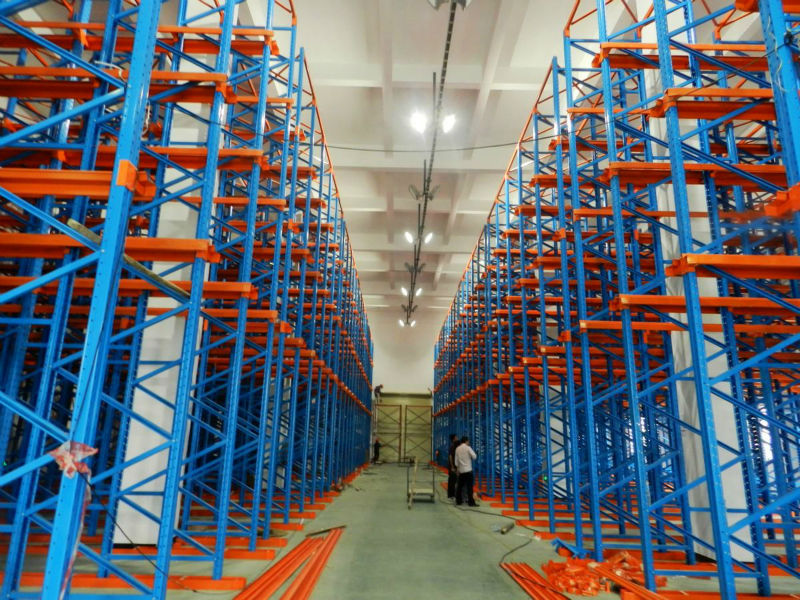
The most common storage solution in modern warehouses relies on selective pallet racks. This configuration offers one-deep storage, providing forklift operators with 100% immediate accessibility to every single SKU in the system. Because no pallets are buried behind others, operators can retrieve any load without moving adjacent inventory. These systems typically utilize wire decking with a 2.5-inch by 4-inch mesh pattern and waterfall edges to secure the loads and comply with fire codes.
These systems are ideal for facilities managing high SKU counts, rapid inventory turnover, and highly varied product lines. If your operation requires constant mixed-pallet picking, selectivity is paramount. However, this accessibility comes with a trade-off. Selective configurations require numerous aisles, resulting in lower overall storage density and a much larger physical footprint compared to deep-lane alternatives.
When floor space is limited and SKU counts are low, high-density configurations maximize your cubic volume. Drive-In and Drive-Thru racking systems are best suited for massive volumes of identical SKUs operating on a LIFO basis. Forklifts drive directly into the storage bays to deposit pallets on continuous rails. This requires strict operator discipline, heavy-duty rub rails, and floor-mounted guide tracks to avoid damaging the internal uprights.
Push-Back racking offers a middle ground, providing two-to-six deep storage using nested carts that roll on inclined steel rails. When a new pallet is loaded, it pushes the existing pallets backward up the slight grade. When a pallet is removed, gravity brings the next one forward to the aisle face. This maintains a LIFO workflow while offering better selectivity than Drive-In systems.
Pallet Flow racking utilizes gravity-driven roller lanes to move pallets from a loading aisle in the back to a picking aisle in the front. This deep-lane storage is the ultimate solution for strict FIFO inventory management. It is heavily utilized in food, beverage, and pharmaceutical industries where expiration dates dictate strict stock rotation.
Standard configurations often fail when tasked with holding oversized, irregularly shaped, or exceptionally heavy loads like metal coils, raw steel, or heavy machinery parts. Implementing proper heavy duty pallet storage requires reinforced uprights, thicker steel gauges, and specialized load beams designed to handle extreme deflection limits. You might need to upgrade from standard 14-gauge steel to thicker 12-gauge or 11-gauge profiles.
You must evaluate the necessity of specialized decking for these loads. Wire mesh decks prevent small items from falling through but may not support concentrated point loads. Solid steel decking or engineered resin boards provide flat, high-capacity surfaces for non-standard containers. Additionally, modern fulfillment centers frequently convert the lower levels of their pallet racks into industrial shelving. This hybrid approach accommodates small-item carton flow or e-commerce piece-picking at ground level while maintaining bulk reserve storage on the upper tiers.
Racking Type | Accessibility | Storage Density | Inventory Flow | Best Use Case |
|---|---|---|---|---|
Selective | 100% | Low | FIFO / Random | High SKU count, varied products |
Drive-In | Low | Very High | LIFO | Large volume of identical SKUs |
Push-Back | Moderate | High | LIFO | Medium SKU count, dense storage |
Pallet Flow | Moderate | High | FIFO | Perishables, date-sensitive goods |
Sourcing heavy industrial equipment across the country introduces massive logistical friction. Searching for industrial pallet racking near me is a strategic move that mitigates the exorbitant freight costs associated with shipping thousands of pounds of steel. A full flatbed truckload of steel weighs up to 40,000 pounds. Shipping that across multiple states costs thousands of dollars. Local sourcing drastically reduces transit times and eliminates the risk of cross-country shipping delays.
Proximity also guarantees rapid on-site facility surveys. A local team can physically walk your warehouse, audit your current workflows, and take precise measurements of your column grids and clear heights. Localized accountability means that if a component arrives damaged or an installation issue arises, the supplier can dispatch a team immediately rather than routing a crew from multiple states away.
When evaluating local entities, you must determine their exact role in the supply chain. Are you dealing with a direct pallet rack manufacturer, a stocking distributor, or a systems integrator? Manufacturers fabricate the steel but may have long factory lead times. Distributors hold inventory locally for rapid deployment but might lack deep engineering support. Integrators design complex automated systems using components from various builders.
Verify their inventory availability before signing contracts. Ask if they stock standard teardrop components, uprights, and wire decking locally. If your project requires standard sizes, a local stocking distributor can deliver materials in days. If they rely entirely on factory shipments, you remain subject to global steel supply chain fluctuations regardless of their local office presence.
The best local partners offer comprehensive turnkey services. Evaluate a warehouse racking supplier based on their ability to provide in-house CAD layout design. They should produce detailed drawings showing exact clearances, aisle widths, and MHE interaction zones. Furthermore, they must provide structural engineering stamps certified for your specific state.
Navigating municipal bureaucracy is a major hurdle in facility upgrades. Your supplier must possess deep expertise in local building codes, seismic regulations, and fire marshal approvals. They should handle the entire High Piled Combustible Storage permitting process, submitting the necessary calculation packages to the city and coordinating the final inspections to ensure your system is legally cleared for use.
The manufacturing process of the steel components dictates the system's durability and capacity. Roll-formed steel is cold-rolled into shape, typically featuring a teardrop punch design. It is highly adjustable, relatively lightweight, and cost-effective for standard commercial warehousing. The teardrop connections allow for rapid beam adjustments without specialized tools.
Structural steel is hot-rolled, resulting in much thicker and heavier components. These systems utilize heavy-duty bolted connections rather than teardrop clips. Structural racks use 3-inch or 4-inch C-channel columns that offer significantly higher load capacities and superior resistance to catastrophic forklift impacts. If your facility operates heavy machinery or handles extreme loads, structural steel is a mandatory requirement to prevent rack collapse.
Every warehouse sits within a specific seismic zone, which dictates the engineering requirements of the storage infrastructure. You cannot simply buy off-the-shelf components and assume they will survive an earthquake. Engineering calculations must account for the facility's soil type, slab thickness, and local seismic activity to determine the required baseplate sizes and anchoring methods. High seismic zones require heavy-duty 1/2-inch by 4-1/4-inch wedge anchors driven deep into the concrete.
Load capacity is a complex interaction between beam ratings and upright frame ratings. Maximum load ratings must account for vertical beam spacing. If you increase the distance between horizontal beam levels, the unsupported span of the upright increases, which drastically reduces the overall weight capacity of the frame. Altering beam elevations without consulting the original engineering documentation can lead to structural failure.
Protecting your steel investment requires proactive safety measures. Forklift impacts are inevitable in high-throughput environments. Integrating column protectors at the base of every aisle-facing upright shields the most vulnerable part of the frame from direct tine strikes. Bullnose end-of-aisle guards wrap around the exposed ends of rack rows, preventing heavy machinery from shearing off the corner columns during tight turns.
Pallet backstops and safety netting prevent loads from being pushed too far back and falling into the flue space or onto pedestrian walkways. Investing in these accessories reduces long-term maintenance costs, minimizes the need for upright replacements, and prevents catastrophic structural failures caused by cumulative impact damage.
Facility design requires navigating the core trade-off matrix between density and access. An industrial pallet racking system built for maximum density sacrifices individual pallet selectivity. Selective racks offer high accessibility and require low initial capital expenditure, but they consume vast amounts of floor space. Deep-lane systems maximize space utilization and offer long-term labor savings by reducing travel time, but they require strict inventory control and higher upfront engineering.
You must map these trade-offs against your specific operational data. If you have 5,000 pallets but only 50 SKUs, density wins. If you have 5,000 pallets and 4,000 SKUs, accessibility is non-negotiable. Forcing the wrong system architecture onto your inventory profile guarantees operational bottlenecks and frustrated warehouse staff.
Business models shift rapidly, and your storage infrastructure must adapt. Assess how easily the system can be expanded or modified. Moving from bulk pallet storage to hybrid micro-fulfillment requires racks that can accept drop-in shelving, carton flow tracks, or automated picking modules without requiring a complete teardown.
Consider the standardization of your components. Universal teardrop compatibility allows you to source replacement beams or wire decks from multiple vendors, avoiding vendor lock-in. However, you must maintain strict adherence to manufacturer load ratings when mixing components. Always ensure that any reconfigurations are reviewed by a structural engineer to verify that the new layout remains safe and compliant.
Procuring heavy steel infrastructure carries inherent supply chain risks. Extended lead times for custom-engineered systems or structural steel components can severely delay your facility launch or expansion timeline. Waiting six months for uprights leaves your inventory sitting on the floor, destroying operational efficiency.
To mitigate this risk, require guaranteed delivery timelines written directly into the procurement contract. Prioritize suppliers who maintain robust local stock for standard components. If a custom color or specific structural profile causes a massive delay, evaluate whether standard stocking materials can achieve the same operational outcome much faster.
Improper installation poses a massive liability. Failed municipal inspections prevent you from legally operating the warehouse. Worse, structural failures due to missing anchor bolts, un-torqued connections, or uncertified installation teams can result in fatal accidents and total inventory loss.
Mandate the use of OSHA-compliant, fully insured installation crews. Do not allow general warehouse staff to erect heavy-duty racking. Require a final engineer sign-off and a formal inspection before a single pallet is loaded into the system. Proper anchoring to the concrete slab, verified plumbness of the uprights, and secure beam locking mechanisms are non-negotiable safety requirements.
Schedule an on-site facility survey with your shortlisted suppliers to verify clear heights, column spacing, and concrete slab conditions.
Request preliminary CAD layouts to visualize MHE interaction zones and calculate exact pallet positions.
Demand detailed load capacity documentation and seismic engineering stamps before signing any procurement contracts.
Audit your forklift fleet to ensure your current reach heights and turning radii match the proposed aisle dimensions.
A: Selective pallet racking is the most widely used configuration. It typically features a teardrop design for easy adjustability. It offers a perfect balance of cost-effectiveness and provides 100% immediate SKU accessibility, making it ideal for warehouses with highly varied product lines.
A: Calculate the maximum weight of your heaviest pallet load and multiply it by the number of pallets per beam level. For upright frame capacity, you must factor in the vertical beam spacing; larger gaps between beam levels significantly reduce the total weight the upright can safely support.
A: Local suppliers drastically reduce heavy freight costs and shorten delivery lead times. They provide rapid on-site design consultations, accurate facility measurements, and possess crucial expertise in navigating your specific municipal building codes and local seismic engineering requirements.
A: Roll-formed racks use cold-rolled steel with teardrop connections, offering cost-effective flexibility for standard loads. Structural racks use hot-rolled steel with bolted connections, providing superior impact resistance and much higher weight capacities, making them mandatory for severe heavy-duty applications.
A: Yes, most municipalities require formal building permits, stamped seismic engineering calculations, and fire marshal approval for any racking system exceeding a certain height, typically 8 feet. Installing without permits risks heavy fines and facility shutdowns.
A: You should avoid mixing brands, even if teardrop designs appear universally compatible. Mixing components voids manufacturer warranties and transfers structural liability entirely to you. Always rely on manufacturer-approved configurations to ensure safe load capacities.
A: Yes. You can integrate heavy-duty industrial shelving, wire mesh decks, or solid decking on the lower levels. This accommodates carton flow or piece-picking operations at ergonomic heights without compromising the structural integrity of the bulk pallet storage on the upper levels.


