

Views: 0 Author: Site Editor Publish Time: 2026-09-25 Origin: Site


Inadequate industrial storage directly correlates with increased picking times, elevated inventory damage rates, and severe workplace safety liabilities. Facility managers must balance the need for high-capacity, durable shelving that withstands daily industrial wear and tear with the logistical realities of freight logistics, long lead times, and complex installation requirements. Relying on substandard storage infrastructure often leads to structural failure, jeopardizing both personnel and inventory.
Evaluating local procurement options for heavy-duty shelving requires a strict assessment of load capacities, material specifications, supplier reliability, and long-term scalability. You need systems engineered to handle massive weight without deflecting or collapsing. Finding the right balance means looking beyond basic dimensions. This guide breaks down the technical criteria for selecting the right system and supplier to optimize your facility layout.
Load Capacity Dictates Design: True heavy-duty systems must support 500 to 1,000+ pounds per shelf, requiring specific steel gauges and reinforced bracing to prevent structural failure and workplace accidents.
Local Procurement Reduces Freight Costs: Sourcing from a regional supplier significantly cuts freight costs, accelerates lead times, and enables on-site facility audits.
Application-Specific Selection: Differentiating between heavy duty metal racks, pallet racking, and stack racks is critical for optimizing space for both bulky inventory and small parts.
Safety and Compliance are Non-Negotiable: Proper installation—including floor anchoring, securing materials, and strategic load distribution—is required to meet OSHA standards and prevent catastrophic failure.
Industrial environments demand storage solutions built to survive constant abuse. Standard commercial shelving bends, warps, and fails under the stress of heavy manufacturing components or dense inventory. You must establish strict technical thresholds when evaluating a heavy duty warehouse shelving system for your facility. The structural integrity of your storage directly impacts daily operational safety and workflow efficiency.
The term "heavy duty" is often misused in marketing materials. True industrial-grade shelving relies on specific manufacturing standards and high-yield steel. Look for 14-gauge or 16-gauge cold-rolled steel construction. Lower gauge numbers indicate thicker, stronger steel. A 14-gauge steel upright provides significantly more rigidity than a 20-gauge commercial alternative. High-capacity systems often utilize steel with a minimum yield strength of 50,000 PSI to ensure the frames do not buckle under maximum load conditions.
Surface finish also matters for long-term durability. Powder-coated finishes resist daily abrasion, chemical spills, and rust far better than standard liquid paint. The powder coating process applies dry powder electrostatically and bakes it into the steel at temperatures exceeding 400 degrees Fahrenheit, creating a hardened, impact-resistant shell. This prevents oxidation in humid warehouse environments, protects against forklift scrapes, and extends the structural life of the metal components.
Engineering dictates shelf capacities. Industrial shelves typically range from 500 lbs to well over 1,500 lbs per level depending on the beam profile and decking material. However, this rating always assumes a Uniformly Distributed Load (UDL). You cannot place a 1,000-pound engine block in the dead center of a shelf rated for 1,000 lbs UDL. The concentrated point load will cause the beam or decking to deflect, permanently deform, and eventually fail.
Strictly adhering to UDL limits prevents catastrophic accidents. When weight is spread evenly across the entire surface area, the structural beams and uprights share the physical stress as intended by the manufacturer. Train your material handling teams to distribute weight symmetrically across the shelf deck. This practice protects your inventory, maintains the structural warranty of the racking, and eliminates the risk of sudden shelf collapse.
A robust shelving system relies on interconnected components working together to maintain rigidity. You need reinforced metal shelves with welded cross-bars or channel supports underneath. These cross-bars prevent the decking material from bowing under sustained heavy loads. The beams themselves should feature a step design or a structural channel to securely hold the decking in place without shifting.
Rigid sway braces are another mandatory component for freestanding units. Installed in an X-pattern on the back and sides of the shelving unit, sway braces prevent lateral movement. When forklifts operate nearby or workers load heavy items, the shelving unit experiences sheer forces. Sway braces absorb and distribute this energy, keeping the uprights perfectly vertical and preventing the entire row from leaning or collapsing like a house of cards.
Heavy loads transfer massive pressure down through the uprights into your concrete floor slab. Large, floor-protecting foot pads, commonly known as base plates, spread this weight over a wider area. This prevents the steel columns from cracking or punching through the concrete over time. Standard base plates measure around 3x4 inches, but heavy-duty applications may require larger 5x8 inch plates to adequately distribute the load.
Base plates must include pre-drilled anchor holes. Anchoring shelves to the floor is a non-negotiable safety requirement in industrial settings. Concrete wedge anchors secure the system against forklift impacts and ensure seismic compliance. If a unit is not anchored, a minor bump from material handling equipment can tip the entire structure. Installers typically use 1/2-inch or 3/4-inch diameter wedge anchors embedded at least 3 inches into the concrete slab.
Technical Feature | Commercial Grade Shelving | Industrial Heavy Duty Shelving |
|---|---|---|
Steel Gauge Thickness | 20-gauge to 22-gauge | 14-gauge to 16-gauge |
Load Capacity (UDL) | 150 - 300 lbs per shelf | 500 - 1,500+ lbs per shelf |
Surface Finish | Standard liquid paint | Industrial baked powder coat or galvanized |
Anchoring Method | Freestanding / Unanchored | Welded base plates with concrete wedge anchors |
Lateral Bracing | Minimal or absent | Heavy-duty side and rear diagonal sway braces |
Decking Support | Flat sheet metal | Wire mesh with welded channel supports |
Selecting the right storage medium depends entirely on your inventory profile. Bulky, irregularly shaped items require different support structures than neatly palletized goods. You must match the physical characteristics of your industrial storage shelves to your specific operational workflows, material handling equipment, and daily picking volumes.
The structural differences between heavy duty metal racks and standard shelving dictate their application. Metal racks utilize heavy roll-formed or structural steel beams that lock into slotted uprights using teardrop or keyhole connections. These beams support various heavy-duty decking materials and can be adjusted in small increments to accommodate changing inventory heights.
Wire mesh decking is common because it allows light and water from overhead fire sprinklers to pass through, meeting strict municipal fire codes. It also prevents dust accumulation and provides high visibility for inventory checks. Solid steel decking is preferred for storing small parts that might fall through wire mesh, or for sliding heavy metal components onto the shelf without snagging. Standard shelving lacks these interchangeable beam profiles and is generally restricted to lighter, hand-loaded boxes in backroom environments.
Knowing when to deploy pallet racks versus heavy-duty shelving is a fundamental layout decision. Use pallet racks exclusively for forklift-accessed, palletized goods. Pallet racks are engineered for high-clearance, heavy-tonnage applications where machines do the lifting. They feature wide spans, typically 96 to 144 inches, to accommodate multiple standard wooden pallets side-by-side.
Deploy heavy-duty shelving for hand-loaded inventory. If your workers are picking bulky items, heavy tools, dies, or industrial parts by hand, shelving provides the appropriate ergonomic access. Shelving units are typically shallower than pallet racks—often 18 to 36 inches deep—ensuring workers do not have to overreach and risk back injuries when retrieving heavy items from the back of the shelf.
Many facilities require a mix of bulk storage and small-item picking. Hybrid systems integrate shelving directly into the lower levels of pallet racks. This setup maximizes vertical cube utilization. The upper levels hold reserve pallets accessed by reach trucks or forklifts, while the ground level serves as a dedicated manual picking zone for individual cartons or loose parts.
You can retrofit existing pallet rack systems with specialized drop-in decking or modular shelf inserts. This conversion accommodates both bulk storage and small-item picking simultaneously within the same footprint. It streamlines the replenishment process, as forklift operators simply drop reserve stock from the top tiers down to the picking shelves below, keeping pickers supplied without requiring them to travel across the warehouse.
Standard shelving cannot accommodate everything. Stack racks offer a viable alternative for seasonal or irregularly shaped inventory. These portable, modular racks consist of a heavy-duty steel base and four removable corner posts. They can be stacked securely on top of one another up to four or five units high when loaded, utilizing vertical space without requiring permanent rack installation.
Stack racks are ideal for items like tires, long pipes, heavy rolls of fabric, or bulk bags that do not fit neatly on standard shelves. When the inventory is depleted, you can dismantle the stack racks and store them densely in a corner, freeing up valuable floor space for other operations. This flexibility makes them a critical component for facilities dealing with fluctuating inventory volumes or seasonal manufacturing runs.
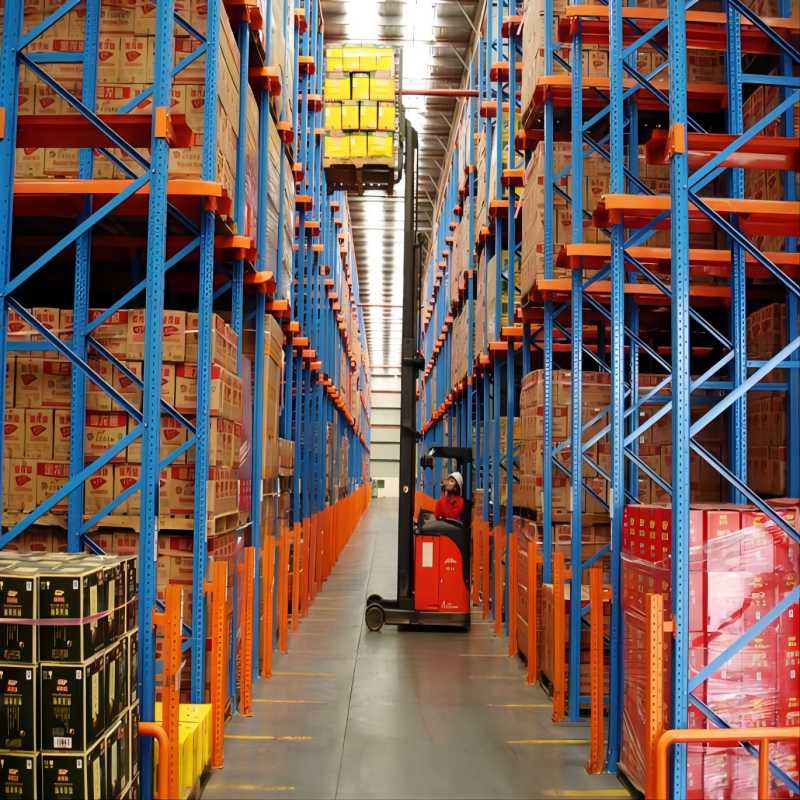
Procurement logistics heavily influence the success of a facility upgrade. Searching for heavy duty warehouse shelving near me offers distinct operational advantages over ordering from distant national distributors. Local sourcing directly impacts your project timeline, installation quality, and overall project management efficiency.
Industrial steel is exceptionally heavy, often shipped by the hundredweight (CWT). Shipping thousands of pounds of steel uprights, beams, and wire decking across the country incurs massive freight charges. These transit costs consume a large portion of your equipment budget. Sourcing from a regional supplier neutralizes this issue. Shorter transit distances drastically reduce freight weight penalties, allowing you to allocate more capital toward higher-quality steel, thicker gauges, or additional storage bays rather than transportation logistics.
Warehouse upgrades often happen in active facilities. You cannot afford to shut down operations for weeks waiting for materials to arrive from overseas or across the country. Regional suppliers facilitate faster delivery schedules. This proximity allows for phased installation, which is critical for maintaining throughput during a facility upgrade.
You can receive materials in manageable batches. Install the first few aisles, move inventory onto the new shelves, and then receive the next batch of steel on a flatbed truck the following week. This phased approach prevents massive disruptions to your ongoing warehouse operations, keeps aisles clear of uninstalled steel, and keeps your fulfillment metrics stable during the transition.
Remote suppliers rely on your measurements, which leaves room for critical errors. Partnering with a local warehouse shelving supplier allows for physical space audits. Representatives can walk your floor, measure clear heights, note column spacing, and identify potential workflow bottlenecks before a single piece of steel is ordered.
These on-site consultations lead to custom layouts that maximize your vertical cube utilization. A local expert will notice overhead obstructions like HVAC ducts, lighting fixtures, or sprinkler lines that you might have missed on a blueprint. They design the system to fit the exact reality of your building, ensuring proper clearances for material handling equipment and pedestrian walkways.
Municipal building codes vary wildly. What passes inspection in one state may fail in another. Local suppliers possess deep expertise regarding regional fire codes, mandatory aisle width regulations, high-pile storage permits, and specific seismic zone anchoring requirements.
If your facility sits in a high seismic zone, the steel gauge, base plate size, and anchor bolt specifications must meet strict engineering standards to withstand ground acceleration. A local provider ensures your system is designed, engineered, and installed to pass municipal inspections the first time. This prevents costly teardowns, re-installations, and delayed occupancy permits that can stall your operations.
Procuring high-quality steel is only the first step. The physical implementation of your warehouse storage solutions dictates the ongoing safety of your facility. Poor installation or improper loading practices will compromise even the strongest shelving systems, leading to structural failure and severe safety hazards.
Safe assembly requires precision and specialized tools. You cannot simply bolt pieces together and start loading inventory. Uprights must be perfectly plumb (vertical) and level. Installers use laser levels and steel shims under the base plates to correct any unevenness in the concrete floor. The industry standard tolerance for plumbness is typically 1/2 inch per 10 feet of height.
Once leveled, anchors must be torqued to the manufacturer's exact specifications. Over-torquing can crack the concrete or strip the anchor, while under-torquing leaves the structure vulnerable to tipping. Finally, safety clips, often called j-pins or drop pins, must be installed at every beam connection point. These clips prevent forklifts from accidentally knocking a beam upward and dislodging it from the upright during pallet retrieval.
System stability relies on a low center of gravity. Always place the heaviest items on the bottom shelves, closest to the floor. Lighter, less dense inventory should occupy the upper levels. This strategic load placement prevents the unit from becoming top-heavy and unstable, especially in environments prone to seismic activity or heavy forklift traffic.
Securing materials on the shelves is equally critical. Vibrations from heavy machinery can cause items to shift and fall over time. Implement material securing methods based on your inventory type:
Install safety netting or steel mesh panels on the back of shelves facing pedestrian aisles to catch falling boxes.
Use heavy-duty plastic bin systems to contain loose parts, hardware, and small components.
Mount edge guards, aisle shields, or wire dividers to prevent cylindrical items from rolling off the decking.
Utilize rack end protectors and column guards to shield the base of the uprights from direct forklift impacts.
Steel shelving is not a set-it-and-forget-it asset. You must define and enforce a strict inspection schedule. Train your warehouse staff to conduct visual inspections weekly. They should look for obvious signs of forklift impact damage, such as dented uprights, twisted diagonal bracing, or sheared anchor bolts.
Look for deflected beams. If a beam remains bowed after the inventory is removed, the steel has yielded its structural integrity and the beam must be replaced immediately. Check for missing safety pins and ensure floor anchors remain tight. Catching these minor issues early prevents catastrophic progressive collapse, where one failed upright brings down the entire row of shelving.
Implementation failures often stem from poor planning rather than bad equipment. A common risk is underestimating the floor slab capacity. Before installing heavy-duty systems, verify that your concrete slab can handle the concentrated point loads exerted by the base plates. Most industrial racking requires a minimum of a 6-inch reinforced concrete slab.
Another frequent failure involves material handling equipment clearances. You must account for the turning radiuses and outrigger dimensions of your specific forklifts or order pickers. If aisles are designed too narrow, equipment will constantly strike the uprights, compromising the structural integrity of the entire system. Always design aisle widths based on the largest piece of equipment operating in that specific zone.
Investing in industrial-grade shelving requires looking past the initial acquisition phase and evaluating the long-term durability of the infrastructure. High-gauge steel systems offer a significantly longer operational lifespan compared to lighter-duty alternatives. When you select 14-gauge steel with a baked powder-coat finish, the system resists the daily wear, tear, and minor impacts that would destroy commercial-grade shelving within a few years.
Scalability and modularity play a massive role in system longevity. As your business grows and inventory profiles change, your storage infrastructure must adapt. Heavy-duty systems are inherently modular. You can easily add extension bays to existing starter units, adjust beam levels on 2-inch centers to accommodate taller pallets, or swap out wire mesh decking for solid steel plates without replacing the entire frame.
Maintenance and repair availability also dictate the lifespan of your storage setup. Partnering with an established regional supplier ensures you have access to exact replacement parts—such as specific teardrop beams, upright frames, or safety clips—over a 10-to-15-year horizon. If a forklift damages a single upright, you can replace that specific component rather than tearing down and replacing the entire aisle, ensuring your storage infrastructure remains safe and functional for decades.
Take the following steps to initiate your storage upgrade and ensure a safe, compliant facility layout:
Conduct a comprehensive inventory audit to determine the exact weights, dimensions, and picking frequencies of the items you need to store.
Measure your available floor space, noting ceiling clear heights, column locations, HVAC obstructions, and floor slab joints.
Request site visits and technical quotes from local industrial shelving providers to compare layout designs, steel gauges, and material specifications.
Verify the seismic zone requirements and high-pile storage permit regulations for your specific municipality before finalizing any structural orders.
Establish a clear timeline for phased installation to minimize disruptions to your daily material handling operations.
A: Industrial storage shelves typically support between 500 and 1,000+ pounds per shelf level. This capacity strictly assumes a Uniformly Distributed Load (UDL). Weight must be spread evenly across the entire shelf surface to prevent beam deflection, structural failure, and potential workplace accidents.
A: Pallet racks are engineered specifically for forklift-loaded, palletized goods requiring high vertical clearance. Heavy-duty shelving is designed for manual picking operations. Choose shelving when workers need to hand-load or retrieve heavy, bulky, or unpalletized items directly from the floor level.
A: Sourcing locally drastically reduces exorbitant freight costs associated with shipping heavy steel. It also ensures faster delivery times, allows for phased installations, and provides access to on-site facility audits to guarantee compliance with local fire and seismic codes.
A: Essential safety features include heavy-gauge steel construction, large base plates with concrete floor anchors, and rigid sway braces for lateral stability. They must also utilize safety clips at beam connections and offer material securing accessories like edge guards or safety netting.
A: Yes. Modular systems can be adapted with various decking materials, vertical dividers, and hybrid configurations. You can even convert the lower levels of existing pallet racks into specialized shelving to accommodate both bulk pallet storage and small-item picking simultaneously.
A: Staff should conduct weekly visual inspections to identify immediate hazards like forklift impact damage or missing safety pins. Additionally, schedule a comprehensive annual audit by a qualified professional to check for beam deflection, anchor integrity, and overall OSHA compliance.


