

Views: 0 Author: Site Editor Publish Time: 2026-08-22 Origin: Site


Modern supply chains operate in a highly volatile climate. Escalating labor costs, unpredictable fulfillment volumes, and shrinking margins constantly threaten facility profitability. Logistics leaders need reliable solutions for predictable material flow. They cannot rely on experimental technology or marketing promises. You can achieve this stability by implementing warehouse automated guided vehicles.
These robotic systems serve as proven, quantifiable tools for optimizing daily operations. Evaluating their tangible efficiency gains helps you build a realistic business case. We will strip away the hype to examine how automation truly performs on the floor. You will discover how strategic deployment resolves severe operational bottlenecks. We will explore integration prerequisites and effective vendor vetting strategies. By mastering these elements, you can permanently transform your fulfillment operations.
Manual material transit often creates hidden inefficiencies across facility floors. Human operators frequently experience "empty travel" during their shifts. This problem occurs when workers drive forklifts between zones without carrying payloads. Empty travel drains valuable labor hours and battery life. It adds zero value to your operational output. Automation directly eliminates this specific waste. Algorithmic dispatching ensures vehicles only move when necessary. They pick up new loads near their last drop-off points. This intelligent routing minimizes wasted movement completely.
Error rates and product damage also decrease significantly after automation deployment. Human-operated forklifts frequently collide into pallet racks or drop delicate loads. These accidents cause expensive inventory shrinkage and facility repair bills. Automated vehicles utilize sensor-guided navigation to move precisely. They process spatial data constantly to avoid obstacles and racks. This reliable accuracy protects your physical infrastructure. It also preserves the integrity of your customer orders.
Standardizing your operational pacing represents another major efficiency leap. Human workers naturally vary their work speeds throughout a long shift. Fatigue slows down line-side delivery and end-of-line takeaway processes. This inconsistency creates unpredictable downstream bottlenecks. Production lines might stall while waiting for raw materials. Automated vehicles enforce a strict, predictable cadence instead. They deliver goods at exact intervals all day. This constant rhythm allows managers to forecast throughput accurately.
Continuous operational capacity dramatically separates automated fleets from manual labor. Human workers require breaks, lunches, and shift changeovers. A typical multi-shift operation loses hours of productivity daily to these transitions. Automated fleets operate continuously around the clock. They utilize opportunity-charging cycles to maintain battery levels. The vehicles dock briefly at charging stations during naturally idle moments. This mathematical advantage compounds daily to drive massive throughput increases.
Dynamic routing transforms how traffic flows through busy facility aisles. Human drivers often cluster in popular picking zones, causing severe gridlock. Fleet management software prevents these traffic jams entirely. The central system monitors every vehicle location in real-time. It assigns optimal pick paths and redirects units away from congested areas. The software acts like an air traffic controller for your floor. It coordinates smooth movement even during peak fulfillment hours.
Space utilization improves drastically when you remove human drivers from the equation. Traditional forklifts require wide aisles for safe maneuvering and turning. These wide aisles consume valuable square footage. Precision navigation allows automated vehicles to operate in much tighter spaces. They require smaller turning radiuses to rotate and place pallets. Managers can reconfigure their facility layouts with narrower aisles. This adjustment increases total usable storage density without expanding the building footprint.
Table 1: Operational Efficiency Comparison
| Metric | Manual Material Handling | Automated Guided Vehicles |
|---|---|---|
| Active Operating Time | 6-7 hours per 8-hour shift | 24/7 (minus opportunity charging) |
| Routing Efficiency | Variable; prone to driver choice | Algorithmic; optimized in real-time |
| Aisle Width Requirement | Wide (10-12 feet typically) | Narrow (optimizes floor space) |
| Pacing Consistency | Fluctuates due to fatigue | Constant, predictable cadence |
Selecting the correct vehicle form factor is crucial for maximizing facility efficiency. Baseline solutions include standard pallet movers and heavy-duty tow tractors. Tow tractors excel at bulk point-to-point transfers across long distances. They pull multiple carts simultaneously to feed assembly lines. Automated pallet movers replicate traditional pallet jack functions efficiently. They handle floor-to-floor transfers effortlessly. However, these baseline models do not fit every material flow scenario perfectly. Different workflows demand specialized robotic form factors.
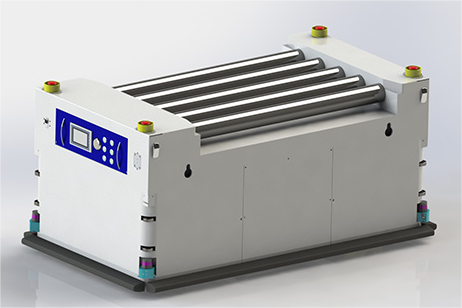
Continuous bridging between automated zones requires a highly specific solution. The Roller AGV serves this exact purpose flawlessly. It features a motorized conveyor top mounted directly onto the mobile base. This vehicle connects stationary conveyor systems across different facility areas. It drives up to a fixed conveyor belt and aligns its sensors. The load handshake happens automatically through synchronized motors. No human intervention slows down this transfer process.
This automated handshake process unlocks incredible workflow efficiencies. The vehicles act as flexible, mobile conveyor extensions. Best-fit use cases include end-of-line sorting and dynamic cross-docking operations. They also thrive in highly automated manufacturing buffers. When a production line finishes a product, the vehicle receives it instantly. It then transports the item directly to the stretch wrapper or outbound dock.
Payload-to-footprint ratio remains a critical evaluation criterion during vehicle selection. You must balance the physical size of the robot against its carrying capacity. Facilities constrained by narrow aisles need compact models. However, these smaller footprints must still handle your heaviest pallets. Review your typical load profiles carefully before purchasing. Match the vehicle specifications to your actual infrastructure constraints.
Chart: Form Factor Capability Matrix
| Vehicle Type | Primary Function | Best-Fit Use Case |
|---|---|---|
| Tow Tractor | Pulling heavy, multi-cart trains | Long-distance milk runs |
| Pallet Mover | Lifting and moving standard pallets | Inbound receiving to storage |
| Roller Deck Unit | Automated load transfers | Bridging stationary conveyors |
Deploying automation requires meticulous preparation behind the scenes. Efficiency only happens when software systems communicate flawlessly. Software integration between your Warehouse Management System (WMS) and the fleet manager is vital. The fleet software needs constant API handshakes to receive inventory tasks. When an order drops, the WMS must trigger the vehicle instantly. Poor API integration leads to delayed dispatches and lost inventory data. IT teams must secure these data bridges before vehicles hit the floor.
Physical environments demand specific prerequisites for successful deployment. You cannot simply drop robots onto a damaged floor and expect perfection. Facility managers must conduct rigorous environmental audits first. Floor flatness dictates the safe traveling speed of your automated fleet. Uneven concrete causes sensor misalignment and emergency stops. You must also map out internal network capabilities carefully.
Safety and compliance heavily influence your calculated throughput rates. Onboard safety protocols interact constantly with human workers. Light Detection and Ranging (LiDAR) scanners map the environment continuously. Mechanical safety bumpers provide physical fail-safes during operation. OSHA and ANSI compliance dictates conservative safety speeds for these units. The vehicles must slow down at intersections and stop for unexpected pedestrians. These necessary safety pauses will impact your theoretical speed calculations. Plan for these realistic constraints when modeling your future material flow.
Building a successful business case requires moving beyond simple upfront price tags. Focus heavily on definitive payback period metrics to gauge true success. Track the exact labor hours saved per shift after deployment. Monitor the reduction in product shrinkage caused by handling errors. Calculate the increased volume of pallets moved per hour. These quantifiable metrics reveal the actual operational value of your investment. Establish these baseline measurements clearly before the new equipment arrives.
Thorough vendor vetting protects your long-term capital expenditure. Do not select partners based solely on theoretical brochures. Demand proof of performance in environments similar to yours. Look for specific evaluation criteria when shortlisting robotics providers. Ask for comprehensive pilot program availability to test the units onsite. Assess their post-deployment support structures closely. You need guaranteed response times if software glitches halt your fleet.
Review proven case studies from companies matching your operational scale. Ask vendors hard questions about integration timelines and network requirements. Verify their claims by speaking directly to their past clients. This rigorous vetting process filters out inexperienced providers quickly. It ensures you partner with experts capable of supporting complex logistical deployments.
Investing in warehouse automation represents a major strategic shift for your business. These robotic systems deliver proven solutions for escalating labor costs and unpredictable flow. Achieving maximum throughput requires rigorous operational auditing prior to deployment. You must match the correct vehicle form factors to your physical layout. You must also ensure seamless communication between your central inventory software and the fleet manager.
Action-oriented next steps:
A: Most multi-shift operations achieve a positive ROI within 18 to 36 months. The payback period accelerates when facilities operate continuously. Reallocating human labor to higher-value tasks and reducing product damage costs drive this rapid return on investment.
A: Yes, integration is highly achievable. It requires matching the vehicle's height adjustability to your existing belt. You must ensure precise optical sensor alignment between both units. Successful deployment also demands careful Programmable Logic Controller (PLC) integration to manage the automated handshakes safely.
A: During a network outage, vehicles safely stop operating. They possess localized navigation capabilities to avoid immediate collisions. However, they rely on central fleet management software for task assignment and dynamic routing. Work resumes once the facility restores the wireless network connection.
A: Automated units generally require less heavy mechanical maintenance than traditional hydraulic forklifts. They experience less physical abuse without human drivers. Maintenance primarily shifts toward scheduled sensor calibrations, software updates, and routine battery management protocols to ensure continuous uptime.


