

Views: 0 Author: Site Editor Publish Time: 2026-08-30 Origin: Site


Guessing pallet rack weight limits leads to catastrophic collapses, compliance fines, and staggering inventory loss. You cannot afford to play a guessing game when employee safety and business continuity are on the line. False assumptions about structural capacities routinely destroy warehouses and halt operations.
There is no universal weight limit for modern storage systems. Capacity remains a highly engineered equation based strictly on steel gauge, component dimensions, and vertical spacing. Every rack system requires exact mathematical validation before you load a single pallet.
This guide breaks down the structural math, safety regulations, and evaluation criteria you need. We will help you determine exactly how much weight a warehouse rack can hold and when to upgrade your system. You will learn to recognize failure points and implement compliant safety standards.
Warehouse buyers often confuse the weight limit of a single shelf with the weight limit of the entire rack system. This misunderstanding creates massive safety hazards. You must separate the capacity of individual horizontal levels from the overall vertical structure. These two numbers dictate your safe working limits.
Load limits apply per pair of beams. When a manufacturer rates a level for 5,000 pounds, they mean the front and rear beam combination can safely support that total weight. You cannot place 5,000 pounds on the front beam alone.
This capacity requires uniform distribution across the entire length of the beam. If you cluster pallets tightly in the center, you create dangerous stress points. The engineering math assumes pallets sit evenly spaced. The weight must spread symmetrically to maintain structural integrity and prevent sudden bowing.
Upright frames represent the vertical steel columns holding everything together. Their capacity defines the maximum vertical weight the structural frames can safely support. This number accounts for the cumulative load of all beam levels combined.
Engineers rely on the "weakest link" rule to determine final system limits. Imagine you have six levels rated at 5,000 pounds each. This creates a potential total of 30,000 pounds. However, if your upright frame is only rated for 20,000 pounds, your system capacity strictly caps at 20,000 pounds. You cannot fully load all six levels without triggering a collapse.
You should always audit existing procurement specs against both beam and frame documentation before adding heavier inventory. A common mistake involves upgrading beams for heavier pallets while ignoring the original upright frames. Always cross-reference both numbers. They work together as a single ecosystem.
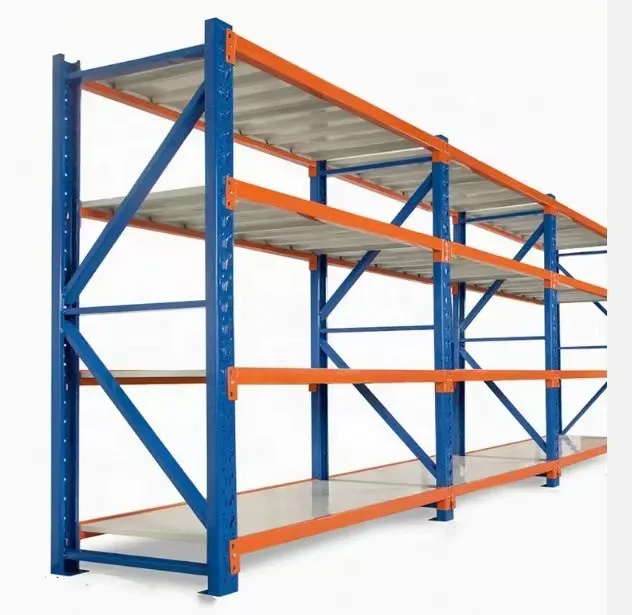
The shape and footprint of your inventory directly impact the safe working load of your racks. You cannot treat a cube of soft paper products the same way you treat a dense metal engine block. Solution categories focus on modifying your rack surface to match your payload footprint.
Standard capacity ratings always assume a Uniformly Distributed Load (UDL). A UDL spreads its weight evenly across the entire contact surface of the beams. Standard pallets typically achieve a UDL because their bottom boards rest evenly across the front and back supports.
Point loading introduces severe danger. This occurs when heavy machinery components or irregular items rest on tiny contact points. The total weight might remain well under the stated beam limit. However, concentrating all that pressure into a few square inches can cause extreme beam deflection. The metal bends, compromises the locking pins, and eventually fails.
Proper decking mitigates point-load risks. We strongly recommend Steel Deck Pallet Racking as a high-durability solution. Solid steel panels support non-standard pallet sizes and heavily concentrated items safely. They capture the footprint of odd-shaped goods and transfer the stress evenly across the supporting beams.
You should understand how different decking options compare. Standard wire mesh prevents loose boxes from falling through. However, it does not bear heavy structural weight. Standard crossbars only stop pallets from slipping between beams. Solid steel systems actively distribute the payload.
Decking Type Comparison Chart
| Decking Material | Primary Function | Point Load Resistance |
|---|---|---|
| Standard Wire Mesh | Prevents product fall-through | Low |
| Pallet Crossbars | Prevents pallet slippage | Minimal |
| Solid Steel Panels | Supports heavy, concentrated loads | High |
Adjusting shelf heights remains a common warehouse practice. Managers frequently move beams to accommodate taller pallets. Unfortunately, this routine task carries severe structural consequences. When managers ask how much weight can a warehouse rack hold, they often overlook the critical variable of beam spacing.
The unsupported span defines the vertical distance between beam levels. It also applies to the gap from the floor to the very first beam level. Uprights rely on horizontal beams to act as stabilizing braces. The beams keep the vertical columns rigid and prevent them from buckling outward under heavy compression.
A strict inverse relationship governs beam spacing. Increasing the distance between beams significantly decreases the upright frame's total weight capacity. If you remove a middle beam level to store taller machinery, you instantly weaken the entire vertical column. The steel has more room to bend. An upright frame rated for 25,000 pounds at a 48-inch beam spacing might drop to 18,000 pounds at a 72-inch spacing.
We strictly warn against adjusting beam levels without consulting the original documentation. You must reference the manufacturer's specific capacity chart. Every system responds differently to spacing changes. Engaging a structural engineer ensures your new configuration remains safe. Never assume the original load limits still apply after you remove or relocate a horizontal level.
A rack rated for 25,000 pounds on paper may effectively hold much less. Environmental and operational realities degrade structural integrity daily. Business owners must account for these hidden variables to prevent catastrophic accidents.
Daily operations inflict micro-damages. Forklift strikes bend the upright bracing. Baseplates rust due to floor mopping chemicals. These imperfections severely reduce overall load capacity. The Rack Manufacturers Institute (RMI) establishes strict guidelines for acceptable wear.
The RMI standard dictates acceptable beam deflection. The rule is Length divided by 180 (L/180). For a 96-inch beam, the maximum safe bow is about half an inch. If the beam remains bowed after you remove the pallet, the steel has yielded. You must replace it immediately.
Geographic location dictates stricter engineering requirements. Warehouses in active seismic zones face severe building codes. The exact same payload requires heavily reinforced racking. Racks in these zones demand heavier steel gauges, thicker baseplates, and specialized anchoring systems. Earthquakes introduce lateral swaying forces. Racks must absorb this lateral shock without buckling under their vertical payloads.
Your racking system can only hold what the concrete floor can support. Engineers measure this in pounds per square inch (PSI) beneath the baseplates. A massive upright frame means nothing if the concrete slab cracks under the pressure. High-density storage requires thick, reinforced concrete slabs. You must verify floor limits before installing heavy-duty frames.
Hidden Capacity Reduction Factors
| Variable | Impact on System | Inspection Action |
|---|---|---|
| Forklift Strikes | Bends vertical columns, drastically lowering frame limit. | Check lower 3 feet of uprights daily. |
| Permanent Beam Bowing | Indicates steel yielding; risk of sudden failure. | Measure deflection (L/180 rule) unloaded. |
| Floor Slab Cracking | Causes racks to lean out of plumb. | Inspect concrete around baseplates monthly. |
Warehouse managers need a clear shortlisting logic. You must audit current systems regularly. This data helps you decide whether to repair damaged components, reconfigure the layout, or replace the entire structure. Relying on visual guesses puts your facility at extreme risk.
Safety begins with proper documentation. LARC stands for Load Application and Rack Configuration. This official blueprint dictates exactly how you must build and load the system.
OSHA and safety compliance boards require prominently displayed load plaques. These plaques must carry an engineer's stamp. They must reflect accurate, up-to-date LARC drawings. If you alter the beam heights, your old LARC drawing becomes void. Verbal estimates from a forklift driver hold no legal or safety value. You must have engineered proof.
Establishing an internal audit routine prevents gradual degradation. Implement the following steps to secure your facility:
If your audit reveals discrepancies, act immediately. Engage an independent rack safety inspector or a licensed racking engineer. They can re-certify altered racks or identify components requiring replacement. If your inventory weight has drastically increased, ask them to spec out a new system. A modern configuration provides the appropriate tolerances for modern supply chain demands.
Determining your exact rack capacity requires more than reading a basic catalog number. It requires calculating horizontal beam limits, vertical frame limits, beam spacing, and precise load distribution. A single weak point compromises the entire structure.
You must rely entirely on manufacturer specifications and engineer-stamped drawings. Guesswork has no place in warehouse safety. Verify your uniform distributed loads and monitor your system for forklift damage. The steel tells a mathematical story you must learn to read.
Do not wait for a collapsed beam to rethink your safety protocols. Schedule a professional rack capacity audit today. If your current system falls short, request a quote for upgraded, compliance-ready racking solutions. Protect your people, your inventory, and your business.
A: There is no universal standard; typical tear-drop beams handle 3,000 to 6,000 lbs per pair, but frames vary wildly from 15,000 to 40,000+ lbs based on engineering.
A: No. Decking improves load distribution and safety but does not increase the structural load limit of the beams or frames.
A: Through updated, engineer-stamped load plaques that correspond to current LARC drawings matching your exact physical configuration.


