

Views: 0 Author: Site Editor Publish Time: 2026-08-16 Origin: Site


Material handling relies heavily on predictable throughput to meet demand. Yet, facility operators face escalating labor shortages, rapid wage inflation, and serious safety liabilities. These combined pressures force logistics leaders to rethink traditional transport workflows.
You can solve these workflow gaps using automated guided vehicles. We define these units as predictable, heavily regulated mobile robots designed specifically for repetitive material transport. They eliminate the variability and safety risks often inherent in human-operated forklift fleets.
Successful adoption requires aligning vehicle payloads, navigation infrastructure, and fleet software around your specific operational bottlenecks. In this guide, you will learn how to evaluate different form factors and identify proven industrial applications. You will also discover actionable steps to shortlist vendors and seamlessly integrate automation into your facility.
You should never pursue automation merely for the sake of modernizing. Facility leaders must define strict success criteria before exploring hardware. You need measurable metrics to justify the initial capital investment. Target clear cost-per-pick reductions across your high-volume aisles. Track the decrease in forklift-related safety incidents. Measure throughput consistency across multiple operational shifts. When you tie these metrics to business outcomes, the project gains immediate stakeholder alignment.
Addressing the ongoing labor and safety equation remains critical. Repetitive transport roles suffer from exceptionally high burnout and turnover rates. Finding reliable personnel to drive routes all day is increasingly difficult. Furthermore, manual material handling introduces serious OSHA compliance risks. Human fatigue leads to collisions, dropped pallets, and structural rack damage. You can mitigate these liabilities using automated fleets. Robots do not suffer from fatigue or mid-shift distractions.
However, setting realistic expectations dictates your ultimate success. These robots prioritize predictable movement over dynamic flexibility. They excel in fixed, repetitive routes where processes rarely change. If your facility requires constant layout shifts or ad-hoc routing, you must plan carefully. The technology thrives on established routines rather than spontaneous problem-solving.
You must choose the right vehicle shape and function for your specific layout. Form factors vary widely depending on payload weight and aisle dimensions. Understanding these categories prevents costly mismatches on the facility floor.
Tow tractors and forklift models handle heavy, traditional payloads. They replace standard manual movements within established, wide aisles. Tow tractors can pull multiple carts in a train formation. This maximizes the volume of goods moved per trip. Forklift models lift pallets to high rack positions safely. They eliminate the need for human operators at dangerous heights.
Unit load and custom carriers serve entirely different needs. Engineers design them for specific, awkward manufacturing components. We see them handling unwieldy items like automotive chassis or massive heavy paper rolls. They sit underneath the custom load and move it safely across the facility.
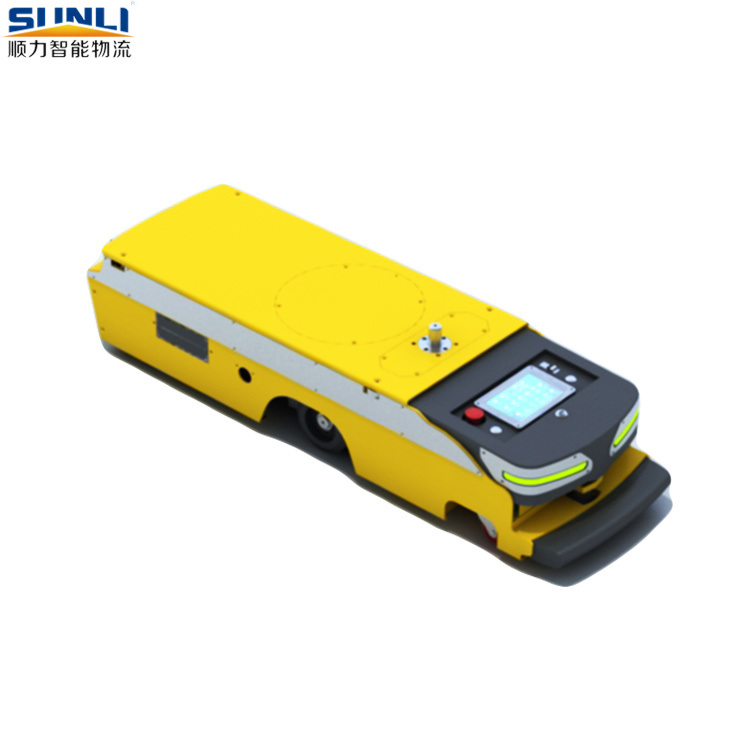
Latent and underride models focus purely on space efficiency. They offer high modularity for incredibly tight layouts. A standout option in this category is the Unidirectional Latent AGV. It navigates smoothly beneath existing carts or storage racks. The robot locks itself in place to transport materials securely. It thrives in highly constrained footprints where every inch matters. Multidirectional movement is not always strictly necessary in narrow corridors. If throughput speed matters most, this single-direction format excels brilliantly.
Navigation methods also dictate your overall facility readiness. You must choose a guidance system that matches your operational environment. Let us compare the primary navigation dependencies below.
| Navigation Type | Reliability Level | Flexibility | Facility Infrastructure Required |
|---|---|---|---|
| Magnetic Tape / Wire | Extremely High | Low (Fixed Paths) | Physical tape on floor or embedded floor wires |
| Laser Targeting | High | Moderate | Reflective targets mounted on walls and racks |
| LiDAR / Natural Feature | Moderate to High | High | Clear lines of sight, minimal structural changes |
These systems succeed across a wide variety of industrial environments. They handle tasks ranging from raw material delivery to finished goods staging. Understanding proven use cases helps you identify similar bottlenecks in your operations.
Manufacturing and assembly lines rely on them heavily. They deliver crucial parts using Just-in-Time (JIT) methodologies. This keeps assembly cells fed without crowding the floor with excess inventory. They also transfer work-in-progress (WIP) materials between specialized workstations. This ensures a steady, uninterrupted flow of production.
Warehousing and distribution centers deploy them for massive volume handling. Robots execute repetitive pallet put-away tasks in deep storage aisles. Distribution hubs use them for rapid cross-docking operations. They move inbound pallets directly to outbound shipping lanes. Some advanced facilities even utilize them for automated trailer loading and unloading.
End-of-line production benefits greatly from robotic transport. Robots carry finished goods directly from the final packaging station. They move these items seamlessly to stretch wrappers or outbound staging lanes. They complete this repetitive workflow entirely without human intervention. This eliminates a major bottleneck at the end of the shift.
Cleanrooms and cold storage present highly unique environmental challenges. Harsh operating environments require strict safety and health regulations. Human presence often introduces severe contamination risks in pharmaceutical or semiconductor cleanrooms. Additionally, climate-controlled break cycles for humans in deep-freeze storage are highly expensive. Robots operate continuously in these extreme conditions without compromising product integrity.
| Industry Sector | Primary Application | Key Benefit |
|---|---|---|
| Automotive Manufacturing | Chassis and JIT parts delivery | Paces assembly lines perfectly |
| Food & Beverage | Cold storage pallet put-away | Eliminates extreme human climate exposure |
| Pharmaceuticals | Cleanroom WIP transport | Removes human contamination risks |
| E-Commerce Distribution | Cross-docking and staging | Accelerates dock-to-door throughput |
Evaluating these systems goes far beyond inspecting physical hardware. The vehicle itself represents only half of your operational solution. You must deeply assess the vendor's Fleet Management System (FMS). This central software handles highly complex traffic control protocols. It dictates right-of-way rules at busy facility intersections. It also manages automated battery charging schedules so robots never die mid-task. Crucially, the FMS manages essential data handshakes between the robot fleet and your central WMS.
Scalability deserves significant attention during the evaluation phase. Can you easily add new vehicles to the system later? Business growth requires adaptable material handling solutions. Expanding your fleet should never require a massive software overhaul. It should not cause extended facility downtime either. Seek software architectures that allow plug-and-play expansions.
Safety and compliance standards remain absolutely non-negotiable. Industrial environments feature heavy foot traffic and unpredictable human movements. Verify strict vendor adherence to ANSI B56.5 and ISO 3691-4 safety protocols. You must evaluate the redundancy of onboard safety sensors. Look for highly rated PLd safety laser scanners. Check for reliable bumper switches and emergency stop accessibility. These redundancies prevent catastrophic workplace injuries.
Deploying advanced automation introduces real-world physical friction. You must audit your facility infrastructure constraints closely before signing a contract. Assess the flatness and surface friction of your concrete floors. Uneven floors cause navigation errors and accelerate wheel wear. Measure existing aisle widths accurately to ensure safe passing clearances. You must also establish and enforce clear drop-off zones.
Network reliability directly dictates your overall system uptime. These robots require constant communication with the central server. Dead zones in your facility Wi-Fi will cause immediate fleet stoppage. The same vulnerability applies to private 5G networks. You must map your entire facility and resolve connectivity gaps prior to deployment. A dropped signal means a stopped production line.
Change management requires careful, proactive leadership. You must train floor staff thoroughly on robotic interaction. They need to understand how the machines navigate and where their blind spots exist. Address early employee skepticism directly and honestly. Smooth out workflow friction during the initial transition period. When workers trust the technology, overall productivity increases.
Vendor interoperability presents another significant industry hurdle. You might want to mix different robot brands in the future. The VDA 5050 standard attempts to unify communication commands across different manufacturers. However, mixing diverse brands on a single floor remains highly challenging in reality. Acknowledge these integration limits early to avoid future vendor lock-in issues.
How do you select the best integration partner for your facility? You must follow a structured, data-driven evaluation process. Proceeding blindly leads to mismatched hardware and frustrated teams.
Running a pilot program under stress reveals true system capabilities. You need to know how the battery management software reacts during maximum output. Local spare parts availability prevents minor hardware failures from causing week-long delays. Fast diagnostic response times prevent costly operational bottlenecks. A comprehensive audit ensures you do not face surprise IT upgrades during deployment week.
Evaluating material transport automation requires a deeply skeptical, data-driven approach. You must focus heavily on facility readiness and software architecture. Deep WMS integration matters significantly more than shiny robotic hardware. Always match the specific vehicle form factor to your actual physical constraints. A highly targeted unit, like the Unidirectional Latent AGV, often outperforms generic alternatives in tight, demanding spaces.
The time to modernize your repetitive transport loops is now. Take decisive action today by mapping out your baseline material flow data. Identify your highest-turnover driving roles and measure your aisle capacities. Schedule a technical site assessment to uncover hidden workflow bottlenecks. By preparing your infrastructure first, you guarantee a smoother, safer transition into automated material handling.
A: The timeline heavily depends on your shift volume. Facilities running continuous multi-shift operations typically see returns within 18 to 36 months. High utilization maximizes labor reallocation and throughput gains. Single-shift operations take longer to realize equivalent financial returns because the robots sit idle overnight.
A: The difference lies in navigation logic. AGVs follow fixed infrastructure paths like magnetic tape or laser reflectors. They stop completely when they encounter an obstacle. AMRs (Autonomous Mobile Robots) use dynamic path planning software to navigate. They actively steer around obstacles to find alternate routes to their destination.
A: No, strict integration is not mandatory for very small fleets. You can operate them using standalone push-button stations or tablet dispatching. However, fully integrated setups require WMS handshakes. This enables automated, real-time dispatching without any manual human triggers.
A: They require predictable, unobstructed environments. You must dedicate specific staging lanes and maintain strictly clear aisles. You may also need to upgrade facility infrastructure. This often includes modifying automatic fire doors, flattening uneven concrete floor surfaces, and removing blind corners.


