

Views: 0 Author: Site Editor Publish Time: 2026-08-17 Origin: Site


Modern intralogistics faces severe and mounting constraints today. Labor volatility continuously disrupts daily schedules and operational consistency. Rising throughput demands push existing facilities to their absolute limits. Meanwhile, margin compression forces supply chain leaders to rethink every single process. In this challenging climate, warehouse automation is no longer an experimental upgrade. It represents a necessary baseline for highly competitive facility design. If you want to survive and scale, you must modernize your operations. Understanding what are automated guided vehicles is the crucial first step toward building a resilient supply chain. We will move far beyond basic definitions in this comprehensive guide. You will learn how enterprise environments evaluate, integrate, and scale these complex systems. We will explore core vehicle types, navigation methods, and practical deployment strategies. You will also discover how to navigate physical risks and choose the exact hardware for your unique operational needs.
We define them as industrial transport vehicles operating autonomously. They move heavy materials without an onboard human operator. They rely heavily on established navigational infrastructure installed throughout a facility. This reliance on fixed routes creates highly predictable traffic patterns. Predictability is vital for maintaining strict safety standards in busy environments.
Engineers design these systems around several distinct navigation types. Each method requires a different level of facility preparation.
The physical vehicle is only one piece of the puzzle. The overarching fleet management system acts as the actual brain. Traffic control software dictates your true throughput efficiency. This software prevents deadlocks at intersections. It assigns missions based on battery levels and proximity. You must evaluate the software backend just as rigorously as the vehicle hardware.
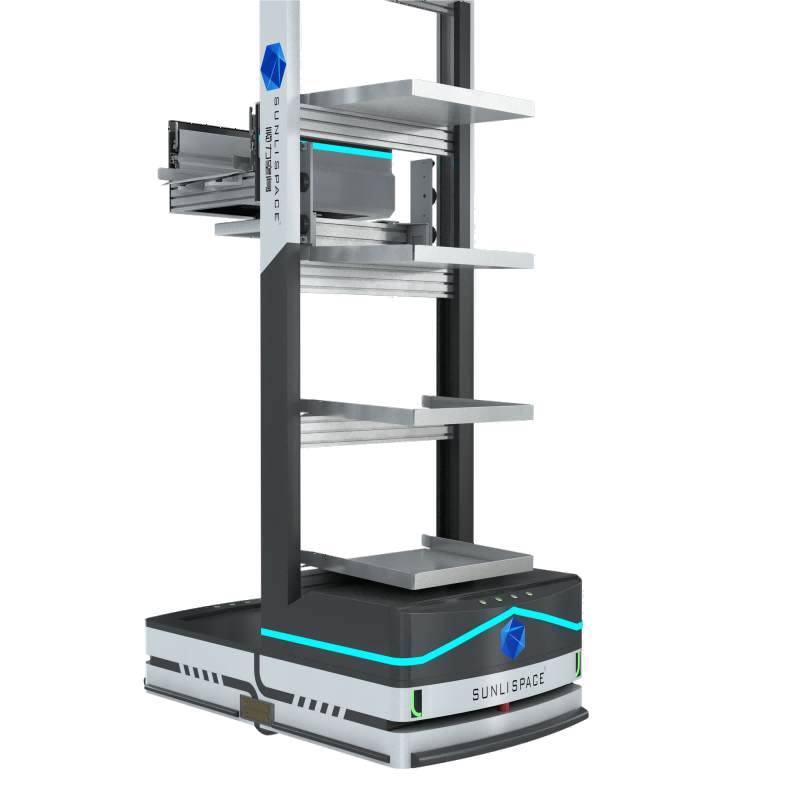
Warehouse environments demand highly specific vehicle configurations. You must match the hardware directly to your daily workflow. Different automation modules handle distinct parts of the modern supply chain.
These units excel at moving heavy payloads over long distances. We see them frequently in busy cross-docking operations. They often pull a train of non-powered carts. They bridge the gap between manufacturing lines and bulk storage areas seamlessly. Tow tractors replace human-driven tuggers, significantly reducing labor dependencies.
Engineers design these specifically for discrete pallet or container transport. Facilities often integrate them directly into existing mechanical workflows. They connect seamlessly to automated storage and retrieval systems (AS/RS). They interface smoothly alongside complex conveyor networks. You will often find them moving finished goods from end-of-line packaging to outbound staging.
These vehicles handle floor-to-floor or rack-to-floor transfers. They bridge the gap between traditional racking structures and modern automation. They allow facilities to automate without rebuilding their entire storage infrastructure. Advanced models can reach high shelving units safely. They utilize specialized sensors to detect pallet pockets accurately before lifting.
Vendors now offer targeted models for highly specific use cases. A prime example is the Cache Bin AGV. Facilities use it for temporary buffering and complex order sequencing. It excels at staging smaller totes in goods-to-person (G2P) picking workflows. It helps micro-fulfillment centers maximize their high-density storage capabilities. These specialized modules represent the future of high-frequency micro-fulfillment.
Buyers often confuse these two automation paths during the procurement phase. The right choice depends heavily on your environmental stability. You must understand how they handle obstacles differently.
AGVs operate on strict, fixed logic. They stop immediately when detecting an obstacle in their path. Autonomous Mobile Robots (AMRs) dynamically map alternative routes around obstructions. An AGV’s predictable stop is often highly preferable. It ensures strict process control. It guarantees higher safety in high-density areas where predictable traffic patterns are mandatory.
AGVs traditionally require more upfront facility modification. You spend more capital expenditure early on installing reflectors or tape. However, they offer highly predictable maintenance schedules. Their throughput models remain incredibly stable over time. AMRs require less physical infrastructure but demand complex software mapping and robust wireless networks.
Expanding a traditional fixed route takes physical effort. You must install new tape, wires, or laser reflectors. You must test the physical path thoroughly. Expanding AMR routes requires only software-level mapping updates. You can deploy AMR fleet extensions rapidly if the network supports them.
Table 1: Operational Decision Matrix
| Evaluation Dimension | Automated Guided Vehicles (AGVs) | Autonomous Mobile Robots (AMRs) |
|---|---|---|
| Navigational Response | Stops and waits for obstacle removal | Dynamically calculates alternative routes |
| Facility Infrastructure Needed | High (reflectors, floor tapes, wires) | Low (relies on software mapping) |
| Ideal Working Environment | Stable, highly controlled, repetitive zones | Dynamic, changing, human-collaborative zones |
| Payload Suitability | Excels at very heavy, bulky loads | Optimized for light to medium loads |
Decision makers must evaluate multiple technical dimensions before signing a contract. You must look far beyond the initial vehicle price tag. Long-term operational viability depends on software, power, and safety integration.
You must map hardware costs against tangible operational savings. Factor in mandatory maintenance contracts carefully. Account for battery replacement cycles accurately. Do not forget recurring software licensing fees. Look at a five-to-seven-year horizon to gauge true profitability. A cheaper vehicle often results in expensive software lock-ins later.
You must assess the vendor's API maturity. It is strictly necessary to evaluate communication protocols. Check if the vendor complies with open standards like VDA 5050. This European standard allows mixed-fleet management natively. It ensures seamless communication via a unified Warehouse Execution System (WES) or Warehouse Management System (WMS). Closed ecosystems limit your future growth.
Evaluate your battery charging strategies closely. Opportunity charging works incredibly well for continuous 24/7 operations. Vehicles dock for brief periods during idle moments. Battery swapping requires manual intervention but minimizes overall fleet downtime. Lithium-ion batteries charge faster and last longer than traditional lead-acid units. Your chosen charging strategy directly impacts your required fleet size calculations.
Verify full compliance with ISO 3691-4 regulations immediately. Demand safety laser scanner redundancy on all units. Ensure emergency stop protocols function perfectly in mixed-traffic zones. Ask vendors how their safety PLd or PLe rated systems integrate into your existing facility fire alarms. Do not compromise on human safety.
Rolling out warehouse automation is an enterprise-level engineering challenge. You will face physical, technical, and cultural hurdles. Preparing for these risks ensures a smooth transition.
Your facility floor quality dictates project success. Assess the surface flatness and expansion joint conditions. Friction coefficients impact navigation sensor accuracy directly. Poor, dusty floors accelerate drive wheel wear. Uneven surfaces cause navigation errors and system-wide halts. Follow VDMA guidelines for industrial floor flatness before deploying any vehicles.
Beware the hidden risk of network latency. Fleet managers require uninterrupted wireless coverage constantly. Low-latency Wi-Fi or private 5G is absolutely non-negotiable. Dead zones lead to immediate system-wide halts. Packet loss during access point handovers compromises your entire daily throughput schedule. Conduct a full wireless site survey first.
Operators often resist robotic integration initially. Mitigate this resistance through comprehensive, transparent safety training. Redefine your warehouse roles clearly. Transition your best staff from manual operators to automation exception handlers. Show them how technology elevates their daily tasks. Human oversight remains critical for resolving robotic bottlenecks.
Do not attempt a massive single-day launch. Follow a structured, phased approach for best results. This mitigates operational risk drastically.
Acquiring these transport systems involves critical process engineering. It is certainly not a simple hardware purchase. You must align the specific vehicle type with your exact throughput requirements. Carefully map the underlying technology against your physical facility constraints. Remember to evaluate the software backend just as rigorously as the steel chassis.
To move forward successfully, take these actionable next steps immediately. Initiate a comprehensive baseline operational audit of your facility. Identify your most stable, repetitive, and labor-intensive transport routes. Request discrete throughput simulations from a shortlist of qualified vendors. Automation forms the foundation of future scalability. Make highly informed choices today to secure your long-term competitive advantage.
A: The return on investment timeline varies heavily based on your specific local labor rates. Shift structures also play a major role. Operations running multiple shifts generally see much faster returns. Most multi-shift facilities achieve full ROI within 1.5 to 3 years. Single-shift operations take slightly longer.
A: Yes, they can operate effectively in cold storage. However, standard models face severe battery degradation in freezing temperatures. You need specialized cold-store models. These units feature internally heated sensor enclosures. They utilize specialized battery chemistries to ensure continuous uptime and prevent condensation-related electrical failures.
A: Standard unit load carriers focus on moving heavy, bulky pallets across long distances. In contrast, a Cache Bin AGV provides a highly specialized function. It targets small-format, high-frequency buffering tasks. Facilities use it to stage and sequence smaller totes in goods-to-person workflows, maximizing high-density storage efficiency.
A: It relies on programmed safety field zones to respond. When an obstacle enters its outer warning zone, the vehicle safely decelerates. If the object breaches the inner stop zone, the system initiates an immediate emergency halt. The system usually requires manual intervention or obstacle removal to resume operation safely.


