

Views: 0 Author: Site Editor Publish Time: 2026-06-01 Origin: Site


A Warehouse Rack is often viewed as a passive piece of metal. But in a commercial storage system, it is the physical constraint—or enabler—of your entire fulfillment operation. Many facilities treat racking as an afterthought. You cannot afford this mistake. Racking design dictates every major operational metric in your building.
For operations managers and procurement teams, the question extends beyond basic utility. You must ask how the correct racking architecture offsets rising industrial real estate costs. A well-designed system reduces forklift travel time dramatically. It also directly dictates your daily labor efficiency. The right choice turns dead space into a strategic asset.
Selecting a warehouse rack system requires moving beyond basic dimensions. You must evaluate complex load engineering and structural integrity. Throughput logic, such as FIFO versus LIFO, must guide your layout. Finally, evaluating the overall financial impact per pallet position is critical. We will explore how to align these elements for maximum facility performance.
Strategic Capacity: Racking shifts the operational metric from square footage (floor space) to cubic volume (vertical clear height).
Cost Realities: Base hardware costs range from $50 to over $400 per pallet position, scaling with storage density and automation.
Workflow Alignment: The core utility of a rack depends entirely on inventory rotation requirements—forcing a high-variety SKU mix into a high-density LIFO rack will throttle picking speed.
Safety & Compliance: True storage utility requires engineered stability, integrating seismic calculations, load capacity plaques, and mandatory fire flue spaces.
Modern industrial real estate expansion is incredibly expensive. Leasing new warehouse space can easily cost upwards of $8 per square foot. Adding a premium racking system offsets the immediate need for facility expansion. Floor stacking limits your capacity to standard pallet heights. Racking systems allow you to reclaim dead air space up to the ceiling. This vertical cube utilization delays capital-intensive building moves. You can double or triple storage capacity within your existing footprint.
Your hardware must dictate your operational flow seamlessly. A well-engineered rack enforces strict inventory logic on the warehouse floor. First-In, First-Out (FIFO) systems physically prevent expiration in food and beverage sectors. Last-In, First-Out (LIFO) configurations clear high-volume, uniform goods rapidly. Using the correct rack prevents constant manual reshuffling by your forklift operators. It automates inventory rotation through structural design. This cuts down labor hours and eliminates costly picking errors.
Floor-stacking pallets directly on top of each other creates massive risks. Bottom-tier pallets often suffer crushing damage from overhead weight. Racking solves this by transferring weight loads directly to the concrete slab. Upright frames handle the vertical compression safely. This protects delicate or expensive inventory from structural failure. Furthermore, it ensures compliance with strict FDA and GMP sanitation standards. Off-the-floor storage allows for proper cleaning and pest control underneath your inventory.
Modern racks do much more than hold boxes. They act as the physical grid for your Warehouse Management System (WMS). Your software relies on specific, mapped bin locations to direct workers. Structurally sound, leveled racking is a strict prerequisite for robotic integration. Automated Guided Vehicles (AGVs) and shuttle systems require precise tolerances. If your racks are misaligned, automation hardware simply cannot function. The physical rack bridges the gap between software commands and real-world execution.
Selective pallet racking is the most common storage system globally. It supports high SKU variety with low-to-medium volume per item. The main advantage is offering 100 percent direct access to any pallet. You never have to move one pallet to reach another. However, it yields the lowest overall storage density due to numerous required aisles. Standard base costs typically range from $50 to $100 per pallet position. It remains the default choice for standard retail fulfillment.
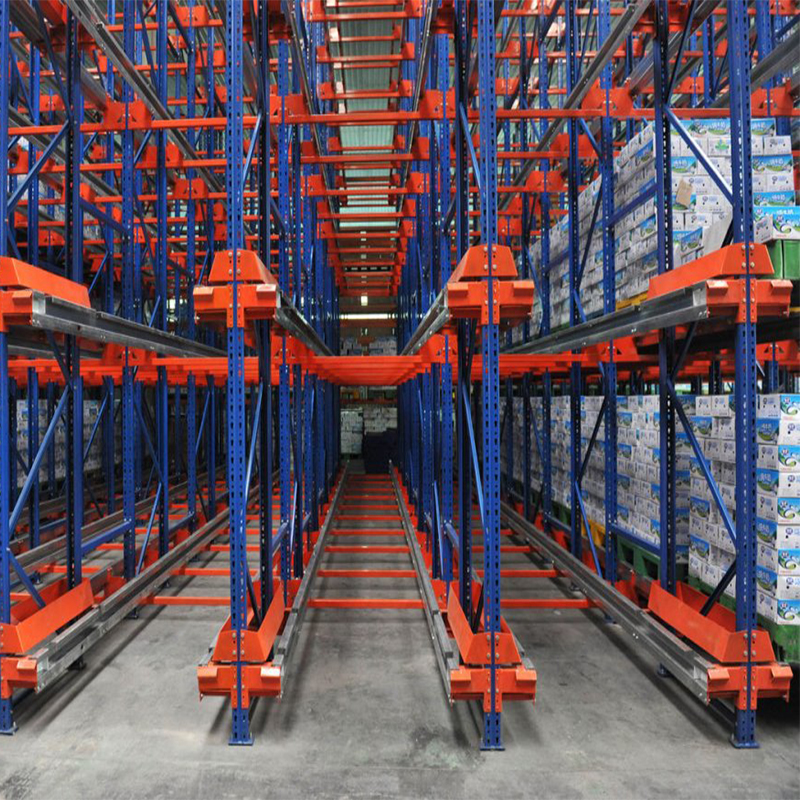
These systems cater to large volumes of homogenous products. They are widely favored for cold storage footprint reduction. Drive-in systems drastically improve density by eliminating picking aisles. However, they demand strict LIFO or batch FIFO discipline. Implementation reality shows an increased risk of forklift impact damage. Drivers must physically enter the rack structure to place loads. Expected cost benchmarks hover around $115 to $140 per pallet position.
Dynamic systems handle high-turnover goods effortlessly. They provide automatic face-replenishment without requiring electricity. Push-back racks use nested carts on inclined rails for dense LIFO storage. Pallet flow racks use gravity rollers for perfect FIFO rotation. These setups are excellent for labor reduction. However, they strictly require uniform, high-quality pallets to prevent track jams. Hardware investments are heavier, costing between $150 and $400+ per pallet position.
VNA systems squeeze maximum capacity into fixed facility footprints. They shrink aisle widths to aggressively reduce wasted floor space. This drastically reduces human labor dependencies over time. The implementation reality requires significant upfront precision. VNA demands specialized wire-guided lift trucks. Your facility must also have exceptionally flat concrete floors, meeting strict F-min ratings. The integration complexity is high, but the space-saving payoff is unmatched.
System Type |
Inventory Logic |
Storage Density |
Selectivity |
Estimated Cost (Per Pallet) |
|---|---|---|---|---|
Selective Pallet |
Agnostic |
Low |
100% |
$50 - $100 |
Drive-In |
Strict LIFO |
High |
Low |
$115 - $140 |
Push-Back |
LIFO |
High |
Medium |
$150 - $300 |
Pallet Flow |
Strict FIFO |
Very High |
Medium |
$200 - $400+ |
Buyers must understand the commercial difference between steel manufacturing methods. Roll-formed steel, commonly using teardrop connections, dominates the market. It is highly adjustable, cost-effective, and ideal for general retail environments. Structural steel uses hot-rolled beams bolted securely together. This heavier option is mandatory for high-abuse environments. High-turnover cross-docks and commercial freezers experience frequent forklift impacts. Structural steel absorbs these massive shocks without catastrophic failure.
You must instruct procurement teams to look beyond the basic frame. Several hidden components define true load-bearing capacity.
Baseplates: These flat steel plates weld to the upright columns. They distribute extreme vertical weight safely across the concrete slab.
Anchoring Systems: Specific concrete anchoring depths prevent the entire structure from tipping during impacts.
Beam Deflection: You must monitor how much the horizontal beams sag under load. Severe deflection indicates overloading and imminent structural failure.
Bracing: Diagonal and horizontal struts keep the upright frames rigid and plumb.
Quality racking is never a simple hardware purchase; it is engineered architecture. Procurement teams must demand comprehensive manufacturer documentation. You need validated seismic calculations for your specific geographic zip code. Localized permitting is often required before installation begins. Furthermore, visible load capacity plaques must be installed on every single bay. These plaques legally state the maximum safe weight limits. Skipping this step invites massive liability and safety risks.
Racking cannot be decoupled from your current forklift fleet capabilities. You must match your hardware closely to your vehicles. Aisle widths must easily accommodate the turn radius of existing lifts. Standard counterbalance forklifts generally require 12 or more feet of aisle clearance. Narrow reach trucks can operate in 8 to 10-foot aisles. If you buy dense racking without checking your forklifts, the system becomes useless. Equipment synergy is a non-negotiable planning step.
Many buyers are shocked by the final installation invoices. The raw steel frame often represents only 70 percent of the cost. A compliant, safe system requires mandatory investments in protective accessories. Wire decking prevents loose cartons from falling between beams. Heavy-duty column guards protect the vulnerable uprights from forklift forks. End-of-row barriers shield the outer rack faces from turning traffic. Rack-back safety netting keeps inventory from dropping into pedestrian walkways.
Ignoring fire codes introduces severe operational and legal risks. Facilities must maintain clear longitudinal and transverse flue spaces. A flue space is the vertical gap between stored pallets. Obstructing these empty spaces prevents fire sprinkler water from penetrating the racks. Warehouse fires spread rapidly when water cannot reach the lower tiers. Blocking flue spaces leads directly to failed OSHA and fire marshal inspections. Keep these gaps clear to maintain building compliance.
Step 1: Audit Physical Constraints. Accurately measure your ceiling clear height. Locate and avoid overhead HVAC ducts and sprinkler drops. Test the concrete slab's PSI load-bearing capacity before ordering heavy structural steel.
Step 2: Map SKU Velocity and Dimensions. Group your current inventory strictly by throughput speed. Standardize your operational pallet sizes, such as GMA versus Euro formats. Accurately weigh your heaviest potential load to determine beam capacities.
Step 3: Run the Density vs. Accessibility Matrix. Determine your acceptable operational trade-offs. Balance the desire to maximize total pallet positions against picking speed. Decide how fast a worker must retrieve a specific SKU.
Step 4: Calculate Comprehensive Hardware Investment. Compare the upfront physical hardware quote against long-term operational offsets. Factor in massive gains in labor efficiency. Account for reduced product damage write-offs. Include the massive savings from avoided lease expansions.
A warehouse rack represents a strategic operational asset, not a commodity purchase. The raw steel dictates how effectively your facility breathes, moves, and scales. Implementing the wrong system forces artificial bottlenecks into your daily supply chain. It frustrates workers and destroys throughput metrics. Conversely, the right system seamlessly marries your specific inventory logic with physical space limits.
You must treat storage design as a highly engineered process. We recommend conducting a comprehensive SKU-velocity audit immediately. Group your items by movement speed before drawing a single floor plan. Finally, consult with a qualified structural engineer or logistics integration specialist. Do this long before signing off on any final layout. Precision planning now prevents disastrous operational bottlenecks tomorrow.
A: Racking is engineered to handle multi-ton, palletized loads. It strictly requires forklifts or automated equipment for loading and retrieval. Shelving handles sub-1,000 pound loads designed for manual, loose-carton picking by human workers.
A: Capacity relies on beam length-to-depth ratios and upright column spacing. It demands uniform weight distribution across the deck. You must calculate the collective weight of all stored tiers, not just the weight of a single pallet.
A: Yes. Routine inspections are absolutely mandatory. Best practices require checking for surface rust, bolt sheer, and anchor pull-out. You must actively monitor for forklift impact damage to prevent sudden structural collapses.


