

Views: 0 Author: Site Editor Publish Time: 2026-08-20 Origin: Site


Moving beyond basic definitions of material handling automation brings us to a critical decision-stage challenge. Warehouse operators must constantly align specific automated systems to physical facility constraints and aggressive throughput targets. The rapid transition from legacy fixed-route setups to dynamic, sensor-rich fleets has heavily fragmented the current robotics market. This technical complexity makes your underlying platform selection the primary driver of either seamless operational scaling or frustrating integration failure.
In this comprehensive guide, we break down how to effectively evaluate core categories of automated guided vehicles technology. You will learn how to properly assess infrastructure requirements, navigate software interoperability, and choose the right power systems. Let us explore the navigation and fleet management frameworks powering modern automation so you can confidently deploy a resilient, future-proof fleet.
Warehouse managers frequently purchase advanced robotic hardware before fully understanding their own operational bottlenecks. This approach leads to underutilized fleets and frustrated floor staff. You must frame the core business problem correctly from day one. Assess the specific gap between your current manual throughput and your target automated throughput. The goal involves bridging this gap without disrupting ongoing daily operations.
Before contacting any automation vendors, operations teams should conduct a rigorous baseline facility audit. The physical environment acts as a strict filter for technology selection. You need to document several critical floor metrics. Evaluate concrete joint conditions, surface friction, and ambient lighting variations. Measure your narrowest aisle widths and map out intersecting traffic zones. Additionally, assess network stability across the entire floor plan. Dead zones in Wi-Fi or 5G coverage will immediately disqualify cloud-dependent navigation technologies. An accurate audit saves months of troubled deployment time.
Finally, operations leaders must define measurable success criteria upfront. Vague goals like "improving efficiency" do not translate into engineering requirements. Establish hard evaluation metrics instead. Define your required Mean Time Between Failures (MTBF) to ensure acceptable reliability. Calculate the maximum acceptable integration timeline. Project the exact fleet size required to handle seasonal peak capacity. These clear metrics allow you to evaluate different vehicle platforms objectively.
Grid navigation remains a cornerstone of modern high-density logistics. Vehicles utilize downward-facing cameras to scan carefully spaced 2D barcodes affixed to the warehouse floor. The robot continuously updates its exact physical coordinates as it passes over each code. This discrete coordinate mapping prevents accumulated positional drift over long distances.
The ideal use case centers around high-density, goods-to-person order fulfillment. Sortation centers and massive e-commerce hubs benefit massively from this grid logic. You can pack storage racks tightly together. The robots travel beneath the racks, lift them, and deliver them directly to human picking stations.
When evaluating a QR Code AGV, operators must consider the operational trade-offs. The system proves highly reliable in static layouts where aisle structures rarely change. It offers a relatively low per-vehicle hardware expense. However, it requires a moderate initial infrastructure setup. Floor maintenance becomes an absolute priority. Scuffed labels, dirt accumulations, or damaged barcodes will abruptly halt a vehicle. Warehouses deploying this tech must implement rigorous daily floor sweeping protocols.
Simultaneous Localization and Mapping (SLAM) represents the cutting edge of flexible robotics. This system uses onboard laser scanners to map the facility in real-time. The robot identifies natural features like structural columns, racking legs, and walls. It compares these scanned features against an internal digital map to navigate autonomously without requiring any physical guides on the floor.
Dynamic environments serve as the ideal habitat for SLAM-based vehicles. Contract logistics providers dealing with frequent layout changes strongly prefer this approach. These systems also excel in shared human-machine workspaces where physical floor guides would be impractical. The vehicles dynamically route around unexpected obstacles like parked forklifts or dropped pallets.
The evaluation lens here focuses heavily on upfront capital and environmental suitability. Buyers face a higher upfront vehicle cost due to expensive sensors and robust onboard processing units. Conversely, facility infrastructure preparation drops to near zero. A common mistake is deploying SLAM in highly reflective or featureless environments. Large expanses of smooth glass, uniform flat walls, or highly polished floors can easily confuse laser scanners.
Reflector navigation relies on strategically placed wall targets. Rotating laser scanners mounted high on the vehicles ping these targets continuously. The vehicle triangulates its exact position based on the return signal angles and distances. This approach mirrors maritime celestial navigation, scaled down to a warehouse environment.
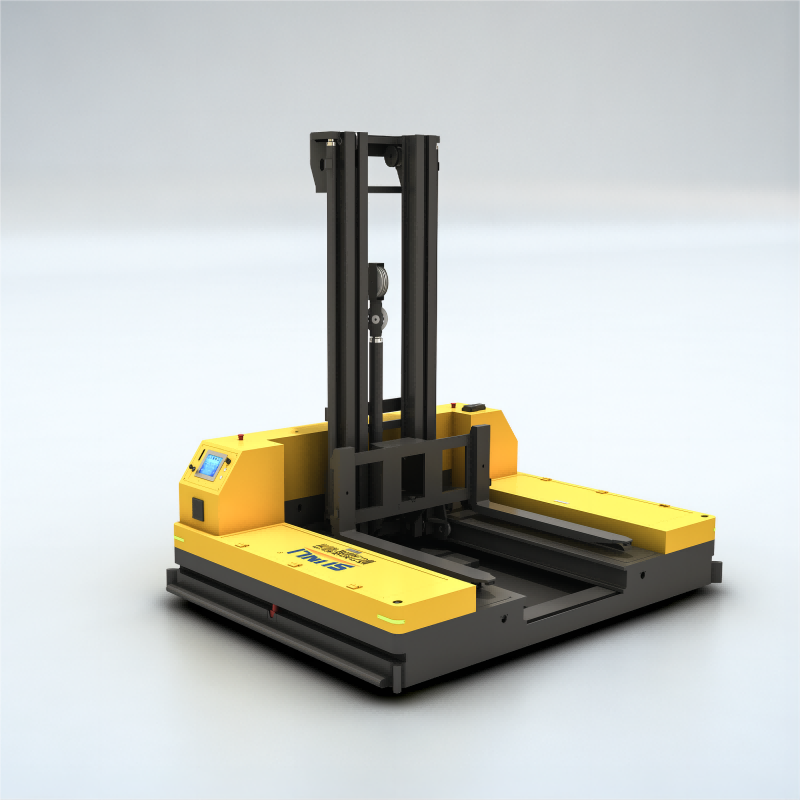
This technology dominates heavy payload transport scenarios. Moving heavy pallets, transporting paper rolls, and feeding manufacturing assembly lines require massive vehicles. These operations demand sub-millimeter positioning precision. A heavy-duty automated forklift must interface perfectly with narrow racking slots to avoid catastrophic collisions.
Evaluating reflector navigation reveals a long history of proven industrial reliability. The precision remains unmatched for high-rack put-away tasks. However, buyers must account for moderate installation time. Technicians must physically mount hundreds of reflectors across the facility walls and racks. They then drive the vehicles manually to map the reflector coordinates before autonomous operations can begin.
Wire and tape systems represent the legacy foundation of automated material handling. Technicians lay physical magnetic tape strips on the floor or cut shallow grooves to embed inductive wires. The vehicles simply follow the magnetic field or inductive signal along a predetermined continuous path.
Strictly fixed, unchanging routes define the ideal use case. Automotive assembly lines frequently use magnetic tape to move chassis slowly from station to station. The paths remain identical for years. Predictability is the primary goal here.
This method offers the lowest technical complexity. Troubleshooting rarely requires software engineers; if the tape breaks, you simply replace the tape. However, this system remains highly rigid. Making layout changes becomes incredibly expensive and disruptive. You must physically halt operations to scrape up tape or cut new concrete grooves.
Navigation Technology Comparison Matrix
| Navigation Type | Flexibility | Precision | Infrastructure Prep |
|---|---|---|---|
| Grid (2D Barcode) | Low/Moderate | High | Moderate (Floor labels) |
| SLAM (LiDAR) | High | Moderate | Zero |
| Reflector | Moderate | Very High | High (Wall targets) |
| Magnetic Tape | Very Low | High | High (Physical pathing) |
Evaluating the physical robot only covers half the automation equation. The Fleet Management System (FMS) acts as the central brain orchestrating your entire floor. The proprietary traffic control algorithm hidden inside the FMS represents the true engine of fleet efficiency. This algorithm handles complex deadlock resolution when two vehicles meet in a narrow aisle. It also calculates dynamic routing to prevent congestion at high-traffic intersections. A poor algorithm will cause bottlenecks, effectively neutralizing the speed advantages of your hardware.
Interoperability determines how well your fleet integrates into your broader business ecosystem. Operations leaders must aggressively assess vendor WMS/ERP integration protocols. Request technical documentation on vendor APIs and RESTful architectures. Legacy systems relying on flat-file transfers severely limit real-time operational visibility. Furthermore, investigate compatibility with emerging industry standards like VDA 5050. This standardized communication interface allows mixed-vendor fleets to communicate smoothly. Relying on VDA 5050 prevents harsh vendor lock-in as your facility expands over the next decade.
Data security and edge computing round out the critical software evaluation layer. Modern navigation demands massive data processing. Shifting computation from centralized cloud servers directly to the onboard vehicle computers reduces command latency. This edge computing approach prevents sudden vehicle stops caused by minor Wi-Fi drops. You must also evaluate network security compliance. Any cloud-connected warehouse technology introduces cyber vulnerabilities. Ensure your vendor supports strict encryption protocols and integrates securely within your existing corporate firewalls.
Robot uptime directly limits facility throughput. Choosing the right onboard power technology ensures your fleet remains active during peak demand. Standard power configurations typically force a choice between advanced Lithium-Ion and traditional Lead-Acid battery chemistries. Lithium-Ion batteries offer significantly longer lifecycle spans and permit rapid opportunity charging without degrading the cells. They provide steady voltage output until nearly depleted. Lead-Acid batteries require specialized charging rooms with ventilation for outgassing. They suffer from slower discharge rates and demand regular watering maintenance. Most modern agile fleets have entirely standardized on Lithium-Ion.
Evaluating charging infrastructure requires aligning physical hardware with your daily shift patterns. Facilities utilize two primary methods to keep fleets moving.
The charging strategy you select directly impacts overall fleet sizing. A common mistake involves calculating fleet size based solely on moving speed. You must account for charging downtime. If vehicles require extensive stationary charging periods, operations managers must purchase additional redundant units. These extra units maintain target throughput during shift changes when a portion of the fleet remains tethered to charging docks.
Deploying heavy machinery across active warehouse floors introduces massive safety liabilities. Risk mitigation starts during the initial procurement phase. You must verify strict sensor redundancy and safety compliance. Reliable automated guided vehicles technology must meet established global safety directives, including ANSI/ITSDF B56.5 and ISO 3691-4 standards. Ensure the vendor utilizes Performance Level d (PL d) or Safety Integrity Level 2 (SIL 2) rated safety laser scanners. The system should combine these advanced scanners with physical safety bumpers and easily accessible emergency stop (e-stop) buttons. Trustworthy vendors embed overlapping safety zones that dynamically shrink or expand based on the vehicle's current velocity.
Move beyond theoretical tech specs by utilizing a comprehensive vendor evaluation matrix. Hardware specifications mean very little if a vendor lacks integration experience. Evaluate their implementation history within your specific industry vertical. Demand explicit clarity regarding Service Level Agreements (SLAs). Assess their local spare parts availability and dedicated support response times. Calculate the estimated Mean Time to Repair (MTTR) for critical components like drive wheels and lift motors. A vehicle stuck waiting weeks for a proprietary replacement part severely damages operational efficiency.
Finalizing your shortlisting logic requires practical validation. Structure a strict Proof of Concept (PoC) pilot test. Isolate a constrained environment within your facility. Test the most complex maneuvers required by your operation. Force the robots to interface with your specific racking types and handle your actual pallet weights. Pilot testing exposes software bugs and network dropouts before you commit to a facility-wide rollout.
Integrating advanced robotics into an active supply chain requires precise planning and deep technical understanding. The optimal hardware stack is always a careful compromise between desired operational flexibility, rigid facility constraints, and firm operational parameters. Whether choosing a highly structured grid approach or a dynamic SLAM setup, success depends heavily on rigorous pre-deployment auditing.
As a next-step action, we highly recommend downloading a comprehensive site-readiness checklist. Alternatively, request a vendor-agnostic facility audit. This objective audit helps map your existing WMS capabilities directly against available hardware options. Establishing a clear understanding of your floor conditions, network stability, and software architecture ensures your automated deployment delivers maximum performance and immediate operational efficiency.
A: The optimal solution depends heavily on your acceptable layout modification levels. SLAM and LiDAR systems minimize upfront facility preparation, saving vast amounts on infrastructure installation. Conversely, magnetic tape systems offer the lowest hardware unit pricing but create high structural rigidity. Facility managers must balance low unit pricing against the disruption of installing physical guides.
A: Advanced systems utilize built-in software redundancies like wheel odometry and inertial dead reckoning to bridge small gaps between readable codes. If a single barcode fails, the vehicle estimates its position until it reads the next one. However, sustained reliable operation strictly mandates rigorous daily floor maintenance and sweeping protocols.
A: Yes. Many sophisticated facilities utilize hybrid navigation approaches. A vehicle might use LiDAR to navigate dynamically through main pedestrian aisles, then switch to laser reflector targeting for high-precision pallet docking. Furthermore, deploying systems compliant with the VDA 5050 protocol allows warehouse managers to operate mixed fleets from entirely different vendors harmoniously.


