

Views: 0 Author: Site Editor Publish Time: 2025-10-23 Origin: Site


An automated guided vehicle forklift is designed to operate without a human driver, efficiently transporting materials throughout a warehouse using state-of-the-art automation. These automated guided vehicle forklifts closely resemble traditional forklifts in appearance but depend entirely on advanced technology for every movement. Key components include laser navigation, 3D LiDAR sensors, and onboard computers. Together, these systems enable the automated guided vehicle forklift to navigate, avoid obstacles, and seamlessly communicate with other automation systems. Gaining a solid understanding of automated guided vehicle forklift technology is essential for optimizing warehouse efficiency.
Technology Type | Description | Contribution to Autonomous Operation |
|---|---|---|
Navigation System | Laser SLAM, Vision Navigation, Magnetic Guidance | Navigates, adapts, and follows paths |
Sensors | 3D LiDAR, Ultrasonic, IMU | Detects obstacles, ensures stability |
Control System | On-board Computers, Communication | Processes data, makes decisions, coordinates operations |
Automated guided vehicle forklifts operate without human drivers, using advanced sensors and navigation systems to transport materials efficiently.
These forklifts can work 24/7, increasing productivity and reducing labor costs while minimizing errors and accidents.
Safety features like collision detection and real-time monitoring help prevent accidents, making warehouses safer for workers.
Integrating automated forklifts with warehouse management systems optimizes routes and improves overall workflow.
Regular maintenance and smart charging practices are essential to keep automated forklifts running efficiently and to extend their lifespan.
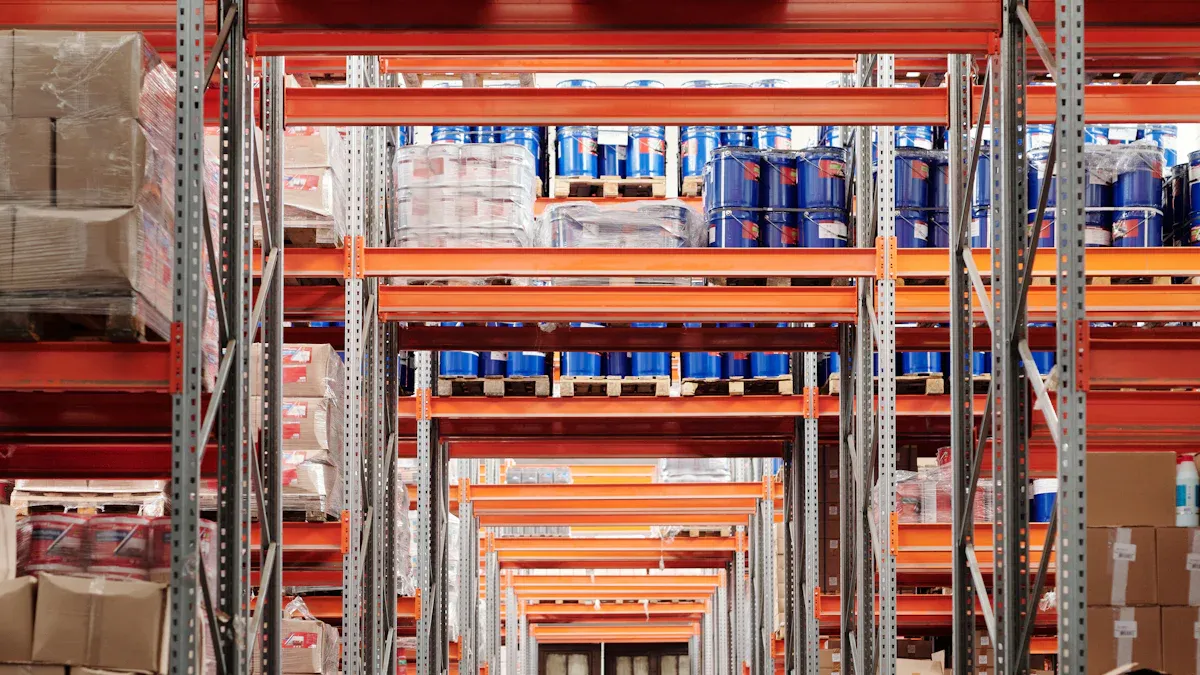
You can think of an automated guided vehicle forklift as a robotic forklift that works without a driver. This machine uses advanced sensors and navigation systems to move, lift, and place loads in your warehouse or factory. Industry standards define an automated guided vehicle forklift as a driverless, self-operating device that can carry, lift, retrieve, and place loads for easy transfer. You will find that these machines handle a wide range of load sizes, from small packages to heavy pallets weighing up to 10,000 pounds or more.
They pick up and drop off loads from the floor, conveyor systems, or storage racks.
You can choose from different designs, such as counterbalance or outrigger models, depending on your needs.
Each model uses a specific lifting mechanism based on the weight and type of load.
The forklift automated guided vehicle moves freely along programmed paths, guided by its navigation system.
Complex algorithms help it map routes and avoid obstacles.
You will often see automated guided vehicle forklifts in places like assembly lines, warehouses, and distribution centers. They transport loads ranging from several hundred kilograms to a few tons. Most use magnetic tape or laser guidance for navigation. Common industries that use these machines include automotive, food, aerospace, and energy.
Tip: If you want to improve efficiency in your warehouse, consider using an automated guided vehicle forklift. These machines can work around the clock and reduce the need for manual labor.
When you compare automated forklifts to manual forklifts, you will notice several important differences. Automated forklifts operate continuously, which boosts productivity and efficiency in moving goods. They follow programmed instructions, so they perform tasks with high precision and reduce errors or product damage. Advanced safety features help them detect obstacles, which lowers the risk of accidents in your facility.
Automated forklifts can work non-stop, even during night shifts.
They use sensors to avoid collisions and keep workers safe.
You can program them for specific tasks, so they complete jobs accurately every time.
Manual forklifts, on the other hand, rely on human drivers. Studies show that there is a 90% chance of a serious accident occurring during the average lifespan of a manual forklift. This highlights the safety concerns with manual operation. The global labor shortage has also left millions of manufacturing jobs unfilled, making automation even more important.
Metric Type | Key Performance Indicators |
|---|---|
Throughput | Cycle time reduction (15-30% improvement), Peak handling capacity (pallets/hour), Multi-shift operation (>95% uptime) |
Safety Performance Indicators | Incident reduction targets, Near-miss elimination, Compliance with safety standards |
Integration Requirements | Real-time data exchange latency (<100ms), System fault tolerance, Cybersecurity protocols |
Performance Optimization | Overall equipment effectiveness (OEE), Mean time between failures (MTBF), Energy consumption per transaction |
You will also find that automated forklifts integrate easily with warehouse management systems. This allows you to track materials, optimize routes, and improve overall workflow. In contrast, manual forklifts require more supervision and do not offer the same level of data integration.
Note: Automated forklifts help you address labor shortages and safety concerns while increasing efficiency in your warehouse.
You will find that sensors and navigation systems form the backbone of every automated guided vehicle. These components help the vehicle see, sense, and move safely in your facility. Most automated guided vehicles use a mix of cameras, LiDAR, ultrasonic sensors, and GPS to understand their surroundings. The table below shows common sensor types and their functions:
Sensor Type | Function |
|---|---|
Vision Guidance | Uses cameras to map routes and build a 3D map. |
LiDAR Sensors | Measures distances with lasers to create a 3D picture of the area. |
Ultrasonic Sensors | Detects objects nearby using sound waves. |
GPS | Provides accurate location data, especially outdoors. |
IMU | Keeps navigation stable using accelerometers and gyroscopes. |
Load Sensors | Measures the weight and balance of loads. |
You may also see advanced navigation systems like magnetic tracks, optical markers, and laser scanners. These systems guide the vehicle along set paths or help it adapt to changes in the environment. Odometry and inertial navigation help track the vehicle’s position and direction from a starting point.
Control systems act as the brain of the automated guided vehicle. They process data from sensors and make decisions in real time. Each vehicle uses dedicated software to manage navigation, obstacle detection, and task execution. A fleet manager can oversee several vehicles at once, assigning tasks and monitoring status. The control system includes:
Controllers that process sensor input and send commands to motors.
Actuators that move the vehicle and lift loads.
Communication networks that allow vehicles to receive instructions and share updates.
Human-machine interfaces (HMIs) for easy setup and monitoring.
You can configure these systems to perform specific tasks, such as moving pallets or delivering materials. Real-time data retrieval helps you optimize routes and improve efficiency.
Safety features protect both people and goods in your facility. Automated guided vehicles use sensors to detect obstacles and stop if something blocks their path. The table below highlights key safety features:
Safety Feature | Description |
|---|---|
Collision Warning Sensor | Stops the vehicle when an obstacle appears. |
Load Position Sensors | Checks that loads are secure and balanced. |
Safety Sensors | Detects people or objects in the vehicle’s path. |
These features help prevent accidents and damage. Most vehicles follow strict safety standards, such as ISO 3691-4:2020 and ANSI/ITSDF B56.5-2019, to ensure safe operation. When you combine sensors, control systems, and safety features, you get a reliable automation solution that keeps your warehouse running smoothly.
You will see automated forklifts navigate your warehouse using advanced guidance systems. These vehicles rely on a combination of sensors and navigation methods to move safely and efficiently. You can choose from several navigation options, each with unique strengths and limitations.
Navigation Method | Pros | Cons |
|---|---|---|
Magnetic Tape AGVs | Economical, Simple reconfiguration, Repetition accuracy | Low traffic, Limited scaling, No auto-avoidance |
Inductive Wire AGVs | Durable, Precision, No environmental interference | Limited reconfiguration, No auto-avoidance, Not suitable for all areas |
Spot Navigation AGVs | Fixed installation, Accurate positioning, Reduced maintenance costs | Installation complexity, Programming-heavy |
Laser Navigation AGVs | Reliable, Easy fleet management, Combinable, Simple rerouting | Infrastructure changes, Environmental disruption |
LIDAR AGVs | Efficient fleet management, No installation, Obstacle avoidance, Easy to scale | N/A |
Laser navigation and LIDAR stand out for their ability to manage complex environments. These systems allow automated forklifts to adapt quickly to changes in warehouse layouts. You benefit from easy fleet management and simple rerouting. LIDAR also enables obstacle avoidance, which is essential for safety.
Automated forklifts use sensor fusion to combine data from multiple sources. LiDAR, vision cameras, infrared, and ultrasonic sensors work together to detect obstacles and measure distances. Intelligent algorithms process this information, helping the vehicle avoid collisions and navigate crowded spaces. You can trust these systems to keep your operations running smoothly, even in dynamic environments.
Tip: Choose navigation methods that match your facility’s complexity and traffic patterns. LIDAR and laser navigation offer the best flexibility and safety for busy warehouses.
Automated forklifts receive instructions from your warehouse management system or fleet manager. You assign tasks such as picking up pallets, moving goods, or placing items on racks. The vehicle processes these commands and plans the most efficient route using its onboard computer.
You will notice that automated forklifts operate with high precision. Sensors guide every movement, ensuring accurate placement and retrieval of loads. The vehicle checks load weight and balance before lifting. It uses 360° safety systems to monitor its surroundings, reducing accidents by up to 90% compared to manual forklifts.
Feature | Automated Guided Vehicle Forklifts | Traditional Forklifts |
|---|---|---|
Operation | 24/7 operation without breaks | Dependent on operator shifts |
Navigation | Precision navigation with sensors | Manual navigation by operators |
Safety | 360° safety systems, reduces accidents by up to 90% | Higher accident rates due to human error |
Cost | Lower long-term costs, reduced labor expenses | Higher labor costs and maintenance expenses |
Automated forklifts work continuously, even during night shifts. You do not need to worry about breaks or fatigue. The vehicle completes tasks efficiently and consistently, which boosts productivity. You can monitor progress in real time and adjust workflows as needed. Automation helps you optimize material flow and reduce labor costs.
Note: Automated forklifts improve safety and efficiency by eliminating human error and providing reliable, round-the-clock operation.
You must keep automated forklifts charged and well-maintained to maximize uptime. Proper charging routines and regular maintenance prevent costly delays and battery failures. You should designate a charging zone in your facility to ensure safe and efficient charging.
Maintenance Practice | Impact on Uptime |
|---|---|
Designate a Charging Zone | Ensures safety and proper charging conditions, reducing downtime due to battery issues. |
Charge at the Right Time | Prevents battery damage and overheating, maintaining operational efficiency. |
Full Charges Only | Extends battery life, minimizing the frequency of replacements and downtime. |
Match Your Charger | Ensures compatibility, preventing charging issues that could lead to downtime. |
Watch the Temperature | Avoids overheating, which can damage batteries and reduce uptime. |
Assign a Watering Champion | Ensures consistent maintenance, preventing battery failure and associated downtime. |
Monitor and Schedule | Regular checks prevent issues that could lead to unexpected downtime. |
Use the Right Water | Ensures battery health, reducing the risk of failures that could impact uptime. |
Water After Charging | Prevents damage to batteries, ensuring they remain operational. |
Specific Gravity Checks | Identifies battery issues early, preventing unexpected downtime. |
Equalizing | Maintains battery health, ensuring consistent performance and uptime. |
Cleaning | Prevents debris-related issues that could lead to downtime. |
Charger Care | Ensures efficient charging, reducing the risk of downtime due to charger failure. |
Seek Help When Necessary | Early intervention can prevent prolonged downtime due to battery issues. |
You should charge batteries after shifts or during breaks to prevent downtime. Routine maintenance extends battery life and improves performance. Smart battery chargers help you avoid overcharging and overheating. Logging battery data allows you to spot issues early and prevent failures. Energy storage audits help you optimize battery usage and maintenance schedules.
Most automated forklifts use lithium-ion batteries. These batteries charge faster than lead-acid batteries and require less maintenance. You benefit from higher energy efficiency and longer lifespan. Quick and partial charging minimizes downtime, which is ideal for multi-shift operations. You can keep your automated guided vehicle forklift running at peak performance with these best practices.
Tip: Regular maintenance and smart charging routines keep your automated forklifts operating efficiently and reduce unexpected downtime.
You will notice a significant boost in efficiency when you add automated forklifts to your warehouse operations. These machines work around the clock, moving goods quickly and accurately. Automated forklifts do not need breaks, so you can keep your material handling processes running smoothly. They use advanced navigation and sensors to transport goods with precision, which reduces errors and increases throughput.
Improvement Type | Description | Measurable Impact |
|---|---|---|
Increased Productivity | AGVs can increase productivity by up to 33% in pick-to-AGV operations. | Up to 33% increase |
Reduced Labor Costs | AGVs operate across multiple shifts, minimizing downtime and saving on labor costs. | Significant cost savings |
Enhanced Safety | AGVs improve safety for both employees and equipment. | Improved safety metrics |
Better Operational Control | AGVs maximize productivity and minimize cycle times across different processes. | Improved operational efficiency |
Automated forklifts improve accuracy in material handling and reduce your reliance on human operators. You can expect better operational control and faster cycle times. These benefits make forklift agvs a smart choice for logistics and material handling.
Automated forklifts help you create a safer warehouse. They use LiDAR, cameras, and other sensors to avoid collisions and detect obstacles. You do not need to worry about operator fatigue or human error, which often cause accidents with manual forklifts. Automated guided vehicle forklift systems can even work in hazardous areas, keeping your team out of harm’s way.
Contribution to Safety | Description |
|---|---|
Reducing Collision Risks | Automated forklifts use advanced technologies like LiDAR and sensors to navigate and avoid obstacles, minimizing collision risks between personnel and equipment. |
Eliminating Operator Fatigue | By taking over physically demanding tasks, automated forklifts reduce the risk of fatigue-related errors among human operators. |
Enhancing Environmental Safety | They can operate in hazardous environments, keeping human workers away from dangerous zones, thus preventing accidents. |
Real-time Monitoring | Equipped with monitoring systems, they can alert operators to anomalies, triggering emergency measures to prevent accidents. |
Compliance with Safety Regulations | Designed to meet safety standards, they incorporate features that enhance on-site safety and assist in regulatory compliance. |
Tip: Automated forklifts help you meet strict safety standards and reduce workplace incidents.
You will see long-term cost savings when you switch to agv forklifts. Automated forklifts lower your ongoing maintenance costs and reduce labor expenses. They also help you avoid costs related to damaged goods, since their precise movements protect your inventory. Over five years, you can save up to $810,000 compared to manual forklifts.
Lower maintenance costs
Reduced labor expenses
Fewer damaged goods
Significant savings over time
Investing in automated forklifts gives you a strong return. You can use these savings to grow your business or invest in more automation for your warehouse.
When you compare forklift agvs to other types of automated guided vehicles, you notice important differences in flexibility and application. Forklift agvs excel at repetitive tasks, such as moving pallets between fixed points. They operate with high automation and require little human interaction. However, other automated guided vehicles, like tow tractors or unit load carriers, may offer more flexibility for different load types and warehouse layouts.
Here is a table that highlights key differences:
Feature | AGV Forklifts | Traditional Forklifts |
|---|---|---|
Automation Level | High automation, minimal human interaction | Requires human operation |
Operation Time | Continuous operation (24/7) | Limited by human shifts |
Space Utilization | Can navigate narrow aisles (as small as 2 meters) | Requires wider aisles for operation |
Load Handling Flexibility | Less flexible, designed for specific tasks | More flexible, can handle diverse loads |
Speed | Slower (almost half the speed of traditional) | Faster operation |
Cost | Higher upfront and maintenance costs | Lower upfront and maintenance costs |
Reliability | Market proven but less flexible | More reliable and flexible in handling tasks |
Application Range | Limited to repetitive tasks | Suitable for a wider range of applications |
You see that forklift agvs work best in environments where you need consistent, repeated movements. Other automated guided vehicles may suit operations that require more adaptability or handle a variety of load types.
Selecting the right automated guided vehicles for your warehouse depends on several factors. You should consider your specific needs and the environment where the vehicles will operate.
Load Capacity: Check the weight and size of the loads you need to move.
Navigation Technology: Decide if you need laser-guided, magnetic-guided, or vision-guided systems for your facility.
Integration: Make sure the AGV can connect with your warehouse management system and other automation tools.
Environment: Think about where the AGV will work, such as indoors or outdoors, and the temperature range.
Flexibility and Scalability: Choose a solution that can grow with your business and adapt to changes.
Many companies choose forklift agvs because they help reduce the need for staff, support continuous operation, and lower error rates. You benefit from fewer accidents and less product damage, which saves money over time.
Fewer staff needed for transport tasks
24/7 operation increases handling capacity
Lower error rates improve safety and reduce costs
Tip: Review your warehouse layout and workflow before making a decision. The right automated guided vehicles can boost efficiency and safety in your operations.
You now understand how an automated guided vehicle forklift works and why it matters for your warehouse. These machines boost material handling efficiency, improve safety, and lower costs. Forklift agvs operate around the clock and help you meet growing industry demands. The market for these solutions continues to grow as companies seek better productivity and automation. If you want to get started, follow these steps:
Assess your current processes.
Set clear goals for automation.
Prepare your facility for AGV navigation.
Integrate AGVs with your systems.
Launch and support ongoing operations.
Tip: Automated guided vehicle forklift technology can transform your warehouse and set you ahead in material handling.
You use an automated guided vehicle forklift to move materials without a driver. This automated guided vehicle system increases efficiency and safety in your warehouse or factory.
Automated guided vehicle forklifts use sensors and cameras to detect obstacles. You reduce accidents and protect workers by relying on these automated guided vehicle advantages.
Yes, you can connect an automated guided vehicle forklift to most warehouse management systems. This integration helps you track inventory and optimize routes.
Look for automated guided vehicle manufacturers with strong support, proven technology, and experience in your industry. Reliable service and customization options help you get the most from your automated guided vehicle forklift.


