

Views: 0 Author: Site Editor Publish Time: 2026-06-08 Origin: Site


Warehouse managers face immense pressure. You must maximize footprint capacity to store growing inventories. At the same time, you cannot bottleneck throughput or compromise worker safety. Balancing dense storage against rapid retrieval speeds creates a core operational dilemma for modern facilities.
Many facility planners assume maximum density automatically means optimized space. This assumption frequently proves false. Theoretical capacity often conflicts directly against usable capacity. Daily inventory flow requirements dictate how much space you can actually use efficiently.
This article objectively compares selective and drive-in warehouse rack systems. We evaluate them based on footprint utilization, capital expenditure, and operational realities like SKU count and turnover rates. You will learn how to parse the data. We provide the insights necessary to make an evidence-based infrastructure decision for your facility.
Drive-in racking provides up to 80% higher theoretical storage density by eliminating forklift aisles, but relies strictly on Last-In, First-Out (LIFO) inventory rotation.
Selective racking offers 100% immediate access to every pallet, making it the industry standard for operations with high SKU diversity, despite requiring more aisle space.
The true cost of a warehouse rack system includes both the initial hardware investment ($50–$80 per pallet position for selective vs. $115–$140 for drive-in) and hidden operational costs like forklift damage or "honeycombing" (wasted space in partially empty drive-in lanes).
Choosing between the two depends fundamentally on the ratio of SKUs to total pallet volume, not just warehouse square footage.
Maximizing warehouse space requires a fundamental shift in perspective. You must differentiate between theoretical density and usable capacity. Theoretical density measures how many pallets physically fit inside a building block. Usable capacity measures how many pallets you can efficiently store and retrieve.
Current operational workflows dictate your usable capacity. High-density storage models look incredible on paper. However, they often introduce severe accessibility restrictions. You trade rapid access for raw volume.
High-density systems introduce a unique operational hazard known as honeycombing. This occurs when a deep storage lane is only partially filled. Because of structural restrictions, you cannot place a different SKU in the empty slots behind the existing pallets.
You lose access to vertical and horizontal space. If a lane holds ten pallets, and you pick three, seven remain. Those three empty slots sit useless until you empty the entire lane. This invisible waste destroys theoretical density metrics.
Any robust infrastructure investment must balance three rigid constraints. We use these baselines to evaluate all storage solutions:
Footprint utilization: The percentage of floor space dedicated to storage versus transit aisles.
SKU selectivity: The ability to access a specific product without moving adjacent products.
Inventory rotation rules: Your operational mandate for First-In, First-Out (FIFO) versus Last-In, First-Out (LIFO) movement.
Common Mistake: Planning a facility based solely on available square footage while ignoring SKU diversity. This error leads directly to severe honeycombing.
A standard Warehouse Rack configured for selective access acts as the backbone of modern logistics. It provides a single-deep configuration. You place pallets one layer deep per aisle.
The architecture remains straightforward but highly effective. It relies on a few critical load-bearing components.
Upright frames: Vertical steel pillars bear the entire weight load.
Horizontal cross beams: These connect the uprights and support the pallets.
Diagonal struts: Bracing between uprights provides lateral stability.
Wire decking or support bars: These rest on the beams to prevent pallets from falling through.
This layout demands a significant footprint cost. You need a dedicated driving aisle for every two rows of racks. The overall density drops dramatically compared to deep-lane alternatives.
However, your space utilization remains highly predictable. You never suffer from honeycombing. A mixed SKU profile does not degrade your total usable capacity.
Selective configurations represent the most cost-effective initial capital expenditure. The industry average baseline cost sits between $50 to $80 per pallet position.
They offer unmatched flexibility. Almost all standard counterbalance forklifts and reach trucks integrate perfectly. You can easily reconfigure beam heights as your product dimensions change.
Ideal Application: E-commerce fulfillment centers thrive on this system. Third-party logistics (3PL) providers use them to manage highly volatile client inventories. Facilities requiring strict FIFO rotation for perishables mandate this accessibility.
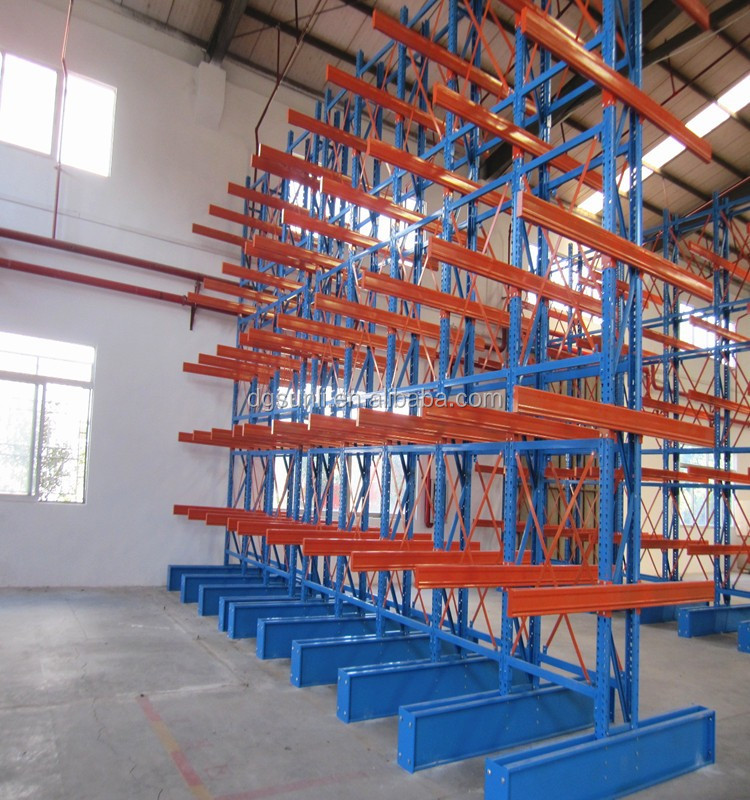
Drive-in systems prioritize absolute maximum density. You completely eliminate standard transit aisles. Forklifts drive directly into the storage bays to deposit or retrieve loads.
The engineering differs significantly from standard single-deep models. You must remove horizontal cross beams from the entry face to allow forklift access.
Support rails: Pallets rest on continuous side ledges instead of front-to-back beams.
Overhead ties: These stabilize the structure across the top, compensating for missing lower cross beams.
Forklift entry guides: Floor-level guides help drivers center their equipment inside the narrow bays.
Heavy-duty column protectors: Steel shields deflect inevitable machinery impacts away from critical uprights.
This method achieves extreme density metrics. Space utilization often reaches up to 80% of the available cubic volume. You can engineer capacity to reach 10 or more pallets deep.
The specialized engineering drives up initial hardware costs. Baseline pricing generally ranges from $115 to $140 per pallet position.
The most rigid constraint remains the LIFO limitation. You must operate on a Last-In, First-Out schedule. You require large batches of homogenous products to fill deep lanes efficiently and avoid honeycombing.
Maintenance risks run exceptionally high. Forklifts operate deep inside the metal framework. Operators must possess high skill levels. Mechanical damage occurs frequently, requiring a larger ongoing maintenance budget.
Ideal Application: Cold storage environments justify the premium cost. High energy prices make refrigerated footprints extremely valuable. Seasonal beverage staging and manufacturing centers handling low SKU counts also benefit immensely.
Evaluating these systems requires looking past raw specifications. We must analyze how they perform under real-world operational stress.
We see stark contrasts across four vital performance categories. They cater to entirely different business models.
Performance Metric | Selective Racks | Drive-In Racks |
|---|---|---|
Footprint Efficiency | Requires many aisles. Wins on usable capacity if handling hundreds of SKUs. | Compresses aisles. Wins on raw density for single-product batches. |
Throughput Velocity | Allows simultaneous, multi-aisle picking. Fast retrieval for mixed orders. | Restricts picking to the front face. Slows down operations significantly. |
SKU Agility | Accommodates rapid inventory profile changes seamlessly. Highly adaptable. | Highly rigid. Changing product profiles renders deep lanes inefficient. |
Safety & Compliance | High visibility. Low collision risk since machinery stays in aisles. | Requires rigorous structural inspections. Internal traffic causes high impact risk. |
Raw density always favors the drive-in model. However, selective systems secure the victory regarding usable capacity if your facility handles hundreds of different SKUs.
Throughput measures the speed of goods moving out the door. Selective layouts allow simultaneous multi-aisle picking. Multiple operators can work concurrently without blocking each other. Drive-in layouts restrict picking to the front face of one lane. This creates severe gridlock when fulfilling mixed orders.
Agility dictates your survival in fluctuating markets. Selective structures accommodate rapid changes in inventory types instantly. You simply adjust beam heights. Drive-in structures remain highly rigid. A sudden shift toward smaller, varied product profiles renders the deep-lane design mathematically inefficient.
Worker safety directly impacts facility compliance. Selective racks offer clear sightlines. Drivers enjoy higher visibility and face lower collision risks. Conversely, drive-in systems mandate rigorous, ongoing structural inspections. Internal forklift traffic practically guarantees eventual mast collisions.
Your ultimate infrastructure choice hinges on specific inventory metrics. You must conduct a thorough data analysis before committing capital.
Choosing incorrectly leads to severe operational bottlenecks. Use the following framework to align your equipment with your business model.
High SKU proliferation. You handle many different products but stock very few pallets per product.
A mandate for strict FIFO inventory rotation. Food, pharmaceuticals, and dated goods require chronological dispatch.
A limited initial capital expenditure budget for hardware acquisition.
A need for highly dynamic, rapid-picking workflows where speed eclipses pure density.
Very few SKUs but massive volume per SKU. You regularly process 20 or more pallets of the exact same item.
High-cost real estate environments. Blast freezers or cold storage facilities justify the premium cost by maximizing vertical density.
Batched dispatch schedules. You ship in bulk, and the LIFO methodology does not impact product expiration.
Many mature facilities discover they do not need to choose just one. They deploy both systems synergistically. You use drive-in racks for fast-moving bulk overstock holding areas. You then replenish selective racks located in forward picking areas. This hybrid method balances raw storage density with rapid fulfillment agility.
"Maximizing space" is a flawed metric if it creates operational gridlock. Drive-in racks mathematically maximize your square footage, but selective racks maximize your throughput agility.
The true system cost goes beyond the purchase order. You must factor in potential honeycombing waste and heightened collision risks when evaluating dense storage.
Your SKU-to-pallet ratio dictates your choice. High SKU diversity demands selective access. Low SKU diversity thrives in deep-lane models.
Warehouse planners must conduct a comprehensive SKU-to-pallet ratio analysis before selecting a system. Do not rely on floor space estimations alone. Map out exactly how many individual product lines you carry against your total pallet volume.
Take action today to future-proof your logistics. Schedule a facility footprint audit. Consult with a qualified warehouse design engineer to model out both storage scenarios using your actual historical inventory data.
A: You must measure two critical dimensions. First, measure the horizontal cross beam length to determine the weight payload capacity per level. Second, measure the upright frame depth and height. This calculates your total physical footprint and vertical storage limits.
A: Direct conversion faces strict limitations. Transitioning to a drive-in system usually requires entirely different structural engineering and heavier components. However, converting to a double-deep reach system serves as an intermediate, higher-density option using existing frames.
A: Yes. Operators must drive machinery directly into tight, dark storage bays. Mast collisions with upright frames happen frequently. You must install heavy-duty rack protection accessories and enforce rigorous driver training to mitigate this inherent risk.
A: Standard counterbalance forklifts require aisles between 12 to 14 feet wide for safe maneuvering. If you utilize narrow-aisle reach trucks, you can compress aisle widths down to 8 or 10 feet, improving your overall footprint utilization.


