

Views: 0 Author: Site Editor Publish Time: 2026-08-19 Origin: Site


Transitioning from manual material handling to automation is no longer just a technology upgrade. It serves as a mandatory operational baseline to combat labor volatility and throughput ceilings. You simply cannot scale efficiently while relying entirely on manual forklifts and pallet jacks. Human labor pools shrink, wages increase, and the physical limitations of manual transport cap your daily productivity.
While AGV technology is mature, the risk of capital misallocation remains exceptionally high. If you fail to map the vehicle type perfectly to your facility's specific workflow, you will drain resources on machinery that underperforms. This guide moves beyond basic definitions. We provide a definitive evaluation framework for the core applications of automated guided vehicles. You will learn how to align technical capabilities with measurable business outcomes. We also explore hardware selection, navigation methodologies, and hidden implementation risks so you can procure systems with absolute confidence.
Audit your existing workflows first. You must identify high-frequency, low-value material transport loops. These repetitive loops currently consume skilled manual labor. Moving goods from point A to point B rarely adds intrinsic value to the product itself. When highly paid operators spend their shifts shuttling empty pallets across a warehouse, you lose money.
Next, establish your primary operational goal. Do you need raw throughput or operational flexibility? Raw throughput focuses on moving bulk tonnage predictably. It prioritizes speed and volume. Flexibility focuses on adapting to changing SKU mixes and dynamic routes. You cannot optimize for both equally without massive capital outlay. Choose your primary driver early in the planning phase.
Define clear ROI indicators before you evaluate any hardware. Do not buy robots just to modernize. Track specific metrics to justify the investment.
These metrics dictate your project's success. Finally, set strict compliance and safety baselines. Industry-standard safety compliance acts as a non-negotiable evaluation lens. Look for adherence to ANSI/ITSDF B56.5 or ISO 3691-4. Any automated transport system you consider must meet these stringent standards to protect your workforce and shield your company from liability.
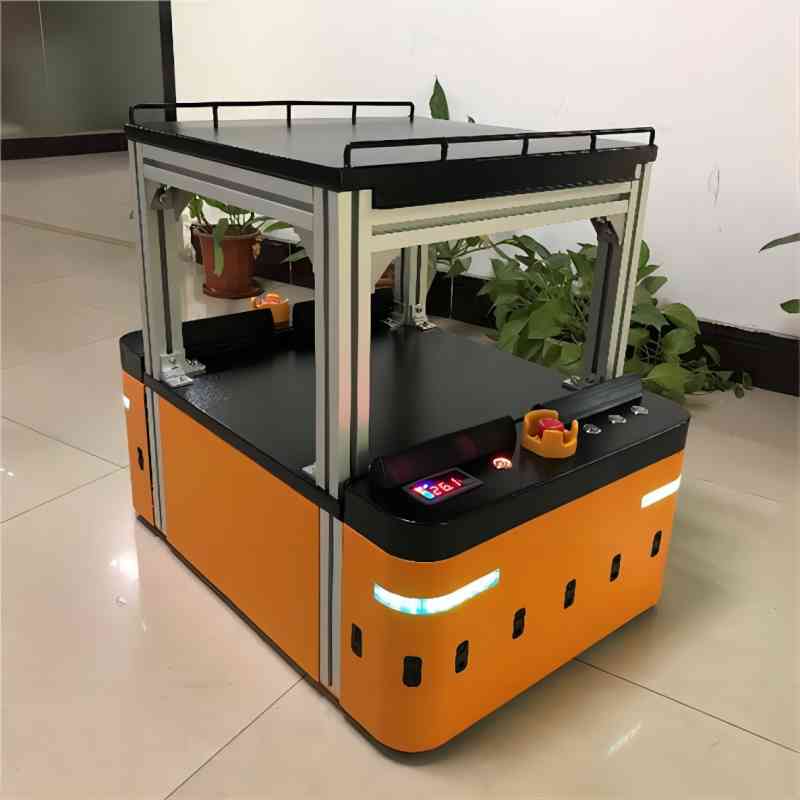
When exploring the applications of automated guided vehicles, you will find four primary use cases. Each addresses specific facility bottlenecks.
First is raw material handling and receiving. Facilities transport bulk goods from receiving docks directly to automated storage and retrieval systems (AS/RS). They also move them to temporary staging areas. You must evaluate these systems on payload capacity and docking precision. If a robot misses the drop-off coordinate by an inch, the entire AS/RS crane cycle halts.
Second is Work-in-Progress (WIP) and lineside feeding. This involves Just-in-Time (JIT) delivery of components to manufacturing assembly lines. Assembly teams rely on absolute timing accuracy. You evaluate this application based on system latency and integration depth with Manufacturing Execution Systems (MES). A delayed parts delivery starves the production line.
Third is end-of-line automation. This workflow moves finished, stretch-wrapped pallets from production to outbound shipping zones. Continuous uptime is critical here. The vehicles must navigate safely through high-traffic, mixed environments where human workers, manual trucks, and robots intersect.
Fourth is hazardous or extreme environment transport. Companies deploy AGVs in cold storage, cleanrooms, or toxic chemical environments. Human presence in these zones introduces contamination risks. It also requires extensive safety overhead, like specialized thermal gear or limited shift durations. Automation eliminates these risks entirely while maintaining a steady flow of materials.
| Application Category | Primary Operational Goal | Core Evaluation Metric |
|---|---|---|
| Raw Material Handling | Bulk transport to AS/RS | Payload capacity & docking precision |
| Lineside Feeding (WIP) | Just-in-Time component delivery | System latency & MES integration |
| End-of-Line Automation | Palletizing to shipping bays | Continuous uptime & obstacle avoidance |
| Hazardous Environments | Cold storage or chemical transport | Environmental resilience & IP rating |
Selecting the correct hardware architecture requires precise spatial mapping. You must align the vehicle type with your facility layout and aisle widths.
Unit load carriers work best for discrete payloads like individual pallets or heavy bins. They travel over moderate distances between production cells. You must carefully assess the transfer mechanisms. Conveyor-to-AGV handoffs require precise alignment, robust optical sensors, and seamless communication protocols.
Automated forklifts and pallet jacks replace traditional rolling stock directly. They suit facilities requiring vertical lifting capabilities. You can deploy them without overhauling your existing rack infrastructure. They reach high storage tiers safely, pulling heavy pallets from top racks without the risk of human operator fatigue.
Tow tractors, or tuggers, excel at moving multiple carts in a single train. We call these milk runs. They operate highly efficiently for bulk transfers across expansive factory floors. However, they require wider turning radii. You must enforce strict aisle-clearance management to prevent bottlenecks, as a tugger train cannot simply reverse out of a blocked corridor.
Platform and specialty AGVs handle unique spatial constraints that standard models cannot. We highly recommend exploring a Two-way Platform AGV for tight manufacturing footprints. A Two-way Platform AGV delivers specific utility where zero-radius turning or bi-directional movement is necessary. It bypasses layout bottlenecks effortlessly. It slides beneath payloads, lifts them from underneath, and reverses direction without needing dedicated turnaround space. This bidirectional capability reclaims valuable square footage for production rather than transport aisles.
Evaluating hardware requires looking past top speeds and maximum payloads. You must scrutinize the underlying technology driving the machines.
Compare navigation methodologies carefully.
Assess scalability and fleet management software closely. Ask how the control system handles traffic deadlocks at four-way intersections. Review the battery charging schedules. Does the vendor support intelligent opportunity charging during idle times, or do they mandate manual battery swapping that requires dedicated human oversight? Also, verify how easily you can commission new vehicles into an existing fleet as your throughput needs grow.
Evaluate data security and IT compliance rigorously. Examine the vendor's data security protocols. Focus specifically on wireless communication vulnerabilities. You need secure, encrypted integration pathways connecting the AGV fleet to your legacy WMS or ERP databases.
Maintain a skeptical lens throughout the evaluation. Avoid vendors promising plug-and-play deployment. True automation never works straight out of the box. Facility mapping, network configuration, and software API handshakes always require site-specific engineering and rigorous testing.
Deploying automation introduces immediate physical and digital friction. You must anticipate these hurdles to keep the project on schedule and budget.
Consider the hidden costs of infrastructure. You will likely face overlooked facility requirements before a single robot arrives. You may need to repair uneven concrete flooring or fill expansion joints to prevent vehicle vibration. Upgrading facility WiFi or 5G access point density is usually mandatory to eliminate dead zones. You might even have to modify physical fire doors with automated relays to allow the robots to pass between zones seamlessly.
Integration friction poses another major risk. API mismatches frequently occur between the AGV Fleet Manager and your facility's existing inventory management systems. Data packets drop. Commands lag. You must dedicate internal IT resources to bridge these software gaps securely. Without tight integration, a robot might arrive at a pickup location before the WMS registers that the pallet is ready.
Address change management and adoption proactively. Operations leaders must plan for comprehensive workforce training. You will need to redefine safety protocols around autonomous zones. Managing employee skepticism is just as important as fixing software bugs. Workers must trust the robots. They need to understand that the machines are there to absorb repetitive labor, not to trigger immediate layoffs.
Adopt a phased rollout strategy. Do not automate your most complex workflow first.
Choosing a vendor requires a long-term partnership mentality. You are not buying a static tool. You are adopting an evolving operational platform that will run for a decade.
Evaluate vendor viability beyond upfront capital expenditure. Look deeply into their post-deployment SLA support structure. Verify the regional availability of spare parts. Ensure they have a local technician presence within a reasonable driving radius. If a mission-critical robot breaks down, waiting a week for a specialized technician paralyzes your production line.
Demand a pilot program or a rigorous proof-of-concept. Shortlisted vendors must conduct an onsite facility audit. Force them to build a digital simulation model using your actual floor plan and historical CAD drawings. They must prove their throughput claims mathematically before you sign a binding contract. If they claim their system moves fifty pallets an hour, make them show it in the simulation dealing with your specific aisle traffic.
Assess all anticipated financial investments systematically. Calculate the base hardware costs and recurring software licensing fees. Factor in physical infrastructure modifications like floor grinding or network upgrades. Budget for comprehensive annual maintenance agreements. Crucially, account for the anticipated production downtime you will experience during the physical integration phase.
The true value of automated logistics lies not in the robotics themselves. It lies in their precise application to specific operational bottlenecks. You only achieve meaningful scale when the hardware architecture perfectly matches the workflow constraint. Slapping high-tech robots onto broken processes only accelerates the chaos.
Ultimately, choosing between a traditional tow tractor or a specialized Two-way Platform AGV comes down to analyzing spatial data and verifying software maturity. Measure your aisle widths, evaluate your floor conditions, and calculate your required turnaround radii carefully.
Stop relying on guesswork. Request a comprehensive facility layout audit today. Download an integration checklist from a certified vendor to prepare your IT team. Contact an application engineer to model your specific workflow and discover your true throughput potential.
A: Deployment timelines vary based on your chosen navigation type and software integration complexity. Generally, a standard rollout takes between 3 to 9 months. Systems using magnetic tape install faster physically but take longer to reroute later. SLAM-based systems require intensive initial software mapping but deploy relatively quickly once the digital environment is finalized.
A: Yes, they can. Modern AGVs utilize advanced safety sensors and LiDAR zones to detect obstacles dynamically. They comply strictly with ISO and ANSI safety standards. However, safe cohabitation requires defined rules of engagement. You must establish clear right-of-way protocols and train your workforce on how the robots behave at intersections.
A: Most facilities achieve ROI within 18 to 36 months. This timeline depends heavily on local labor rates and your shift structures. Operations running three continuous shifts see the fastest returns, as the robots effectively replace multiple shifts of manual labor while maintaining consistent throughput and reducing safety incident costs.
A: When a network drops, AGVs rely on local fail-safes. The onboard computer processes immediate navigational data to execute automatic safe-stop protocols safely. While they cannot receive new destination commands from the cloud fleet manager during an outage, they will not crash. They pause securely until the connection is fully restored.


